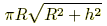
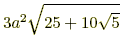
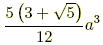
h = Height (perpendicular distance from base to top)
B = Area of the base of the solid
r = Radius of the sphere
π = The constant pi, approximately 3.14159
Worked Example
Problem: Find the volume of a right circular cylinder with a radius of 5 cm and a height of 12 cm.
Step 1: Identify the formula for the volume of a right circular cylinder.
V=πR2h
Step 2: Substitute the given values: radius R = 5 cm and height h = 12 cm.
V=π(5)2(12)
Step 3: Square the radius and multiply.
V=π⋅25⋅12=300π
Step 4: Compute the numerical value.
V≈300×3.14159≈942.48 cm3
Answer:The volume of the cylinder is 300π≈942.48 cm³.
Another Example
This example uses a cone rather than a cylinder, highlighting the critical factor of 1/3 that appears whenever a solid tapers to a point (pyramids and cones) instead of maintaining a constant cross-section.
Problem: A cone-shaped paper cup has a radius of 6 cm and a height of 10 cm. How much water can it hold?
Step 1: Since a cone tapers to a point, its volume is one-third the volume of a cylinder with the same base and height.
V=31πR2h
Step 2: Substitute R = 6 cm and h = 10 cm.
V=31π(6)2(10)
Step 3: Simplify inside the expression first: 6² = 36, and 36 × 10 = 360.
V=31π⋅360=120π
Step 4: Calculate the decimal approximation.
V≈120×3.14159≈376.99 cm3
Answer:The cone holds 120π≈377.0 cm³ of water.
Frequently Asked Questions
What is the difference between volume and surface area?
Volume measures the three-dimensional space inside a solid and is expressed in cubic units (cm³, m³). Surface area measures the total area covering the outside of the solid and is expressed in square units (cm², m²). Think of volume as how much a container can hold, and surface area as how much wrapping paper you would need to cover it.
Why do pyramids and cones have 1/3 in their volume formulas?
A pyramid or cone tapers from its full base down to a single point, so it occupies less space than a prism or cylinder with the same base and height. Rigorous calculus proofs show the ratio is exactly one-third. An intuitive way to see this: you can fill a cone with water exactly three times to fill a cylinder of the same base and height.
How do you find the volume of an irregular shape?
For irregular shapes, you can use water displacement: submerge the object in water and measure how much the water level rises. The displaced volume equals the object's volume. In advanced math, you can also use integration (calculus) to compute volumes by summing infinitely thin cross-sectional slices.
Volume vs. Surface Area
Volume
Surface Area
What it measures
The 3D space enclosed inside a solid
The total area of all outer faces/surfaces of a solid
Units
Cubic units (e.g., cm³, m³, ft³)
Square units (e.g., cm², m², ft²)
Box formula
V = lwh
SA = 2lw + 2lh + 2wh
Sphere formula
V = (4/3)πr³
SA = 4πr²
Real-world analogy
How much water a tank holds
How much paint to coat the tank
Why It Matters
Volume appears throughout geometry courses when you study prisms, cylinders, pyramids, cones, and spheres — it is one of the most tested topics on standardized math exams. Beyond the classroom, volume calculations are essential in science (measuring liquid capacity, gas volumes), engineering (sizing tanks and containers), cooking (converting recipe quantities), and architecture (estimating material for concrete or fill).
Common Mistakes
Mistake: Forgetting the 1/3 factor for pyramids and cones.
Correction: Any solid that tapers to a point uses V = (1/3)Bh, not V = Bh. The factor of 1/3 accounts for the tapering shape. A quick check: a cone should hold exactly one-third the volume of a cylinder with the same base and height.
Mistake: Confusing radius and diameter when computing volume.
Correction: Formulas like V = πR²h and V = (4/3)πr³ require the radius, not the diameter. If you are given the diameter, divide it by 2 before substituting. Using the diameter in place of the radius makes the answer 4 times too large (for cylinders) or 8 times too large (for spheres).