
Rectangular Parallelepiped
Rectangular Parallelepiped
Box
Cuboid
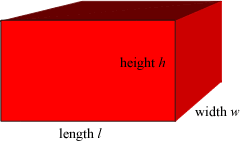
A box shape in three dimensional space. Formally, a polyhedron for which all faces are rectangles.
Rectangular Parallelepiped Volume = lwh |
 |
See also
Right square prism, parallelepiped, volume, lateral surface area, surface area
Key Formula
V=lwhAlateral=2lh+2whAsurface=2lw+2lh+2wh
Where:
- l = Length of the rectangular parallelepiped
- w = Width of the rectangular parallelepiped
- h = Height of the rectangular parallelepiped
- V = Volume — the amount of space enclosed
- Alateral = Lateral surface area — the total area of the four side faces (excluding top and bottom)
- Asurface = Total surface area — the area of all six rectangular faces
Worked Example
Problem: A shipping box has length 10 cm, width 6 cm, and height 4 cm. Find its volume, lateral surface area, and total surface area.
Step 1: Identify the dimensions: l = 10 cm, w = 6 cm, h = 4 cm.
l=10,w=6,h=4
Step 2: Calculate the volume by multiplying length, width, and height.
V=lwh=10×6×4=240 cm3
Step 3: Calculate the lateral surface area. This covers the four side faces only (not the top or bottom).
Alateral=2lh+2wh=2(10)(4)+2(6)(4)=80+48=128 cm2
Step 4: Calculate the total surface area by adding the top and bottom faces to the lateral area.
Asurface=2lw+2lh+2wh=2(10)(6)+80+48=120+128=248 cm2
Answer: Volume = 240 cm³, Lateral Surface Area = 128 cm², Total Surface Area = 248 cm².
Another Example
This example works backward from a known volume to find a missing dimension before computing surface area, showing how the formulas can be rearranged.
Problem: A rectangular parallelepiped has a volume of 360 cm³. Its width is 5 cm and its height is 8 cm. Find the length and the total surface area.
Step 1: Use the volume formula to solve for the unknown length.
V=lwh⟹360=l×5×8=40l
Step 2: Divide both sides by 40 to isolate l.
l=40360=9 cm
Step 3: Now compute the total surface area using l = 9, w = 5, h = 8.
Asurface=2(9)(5)+2(9)(8)+2(5)(8)=90+144+80=314 cm2
Answer: The length is 9 cm and the total surface area is 314 cm².
Frequently Asked Questions
What is the difference between a rectangular parallelepiped and a cube?
A cube is a special case of a rectangular parallelepiped where all three dimensions — length, width, and height — are equal. In a general rectangular parallelepiped, the three dimensions can all be different, so not every face is a square. Every cube is a rectangular parallelepiped, but not every rectangular parallelepiped is a cube.
Is a rectangular parallelepiped the same as a cuboid?
Yes. The terms 'rectangular parallelepiped,' 'cuboid,' and 'rectangular box' all refer to the same shape: a polyhedron with six rectangular faces, eight vertices, and twelve edges. 'Cuboid' is the more common everyday term, while 'rectangular parallelepiped' is used in formal or advanced mathematics.
How do you find the space diagonal of a rectangular parallelepiped?
The space diagonal connects two opposite corners of the box. Its length is found by extending the Pythagorean theorem to three dimensions: d=l2+w2+h2. For example, a box with dimensions 3, 4, and 12 has a space diagonal of 9+16+144=169=13.
Rectangular Parallelepiped (Cuboid) vs. Cube
| Rectangular Parallelepiped (Cuboid) | Cube | |
|---|---|---|
| Definition | A box with all six faces as rectangles; dimensions l, w, h may differ | A box with all six faces as congruent squares; l = w = h = s |
| Volume | V = lwh | V = s³ |
| Surface Area | A = 2lw + 2lh + 2wh | A = 6s² |
| Space Diagonal | d = √(l² + w² + h²) | d = s√3 |
| Number of Faces / Edges / Vertices | 6 faces, 12 edges, 8 vertices | 6 faces, 12 edges, 8 vertices (same topology) |
Why It Matters
The rectangular parallelepiped is the most common solid shape you encounter in everyday life — rooms, boxes, books, and bricks are all examples. Its volume and surface area formulas appear constantly in geometry courses, standardized tests, and real-world tasks like calculating storage capacity or the amount of material needed to wrap a package. Understanding this shape also builds the foundation for working with more complex prisms and higher-dimensional analogs.
Common Mistakes
Mistake: Confusing lateral surface area with total surface area. Students sometimes use the total surface area formula when asked for the lateral area, or vice versa.
Correction: Lateral surface area counts only the four side faces: 2lh + 2wh. Total surface area adds the top and bottom: 2lw + 2lh + 2wh. Always check which quantity the problem asks for.
Mistake: Forgetting the factor of 2 in the surface area formula. Each pair of opposite faces has the same area, so every term must be doubled.
Correction: There are three distinct pairs of opposite faces (lw, lh, wh), each appearing twice. The total surface area is 2(lw + lh + wh), not lw + lh + wh.
Related Terms
- Three Dimensions — The space in which a rectangular parallelepiped exists
- Polyhedron — General class of 3D shapes with flat faces
- Face of a Polyhedron — Each of the six rectangles forming the surface
- Rectangle — The shape of every face of a cuboid
- Right Square Prism — Special case where two opposite faces are squares
- Parallelepiped — General form where faces are parallelograms, not necessarily rectangles
- Volume — Measured by the formula V = lwh
- Lateral Surface Area — Area of the four side faces only
- Surface Area — Total area of all six faces