Problem: Find the total surface area of a rectangular box with length 5 cm, width 3 cm, and height 4 cm.
Step 1: Write the formula for the surface area of a box.
SA=2lw+2lh+2wh
Step 2: Substitute the given values: l = 5, w = 3, h = 4.
SA=2(5)(3)+2(5)(4)+2(3)(4)
Step 3: Calculate each pair of opposite faces separately.
SA=30+40+24
Step 4: Add the three terms to get the total surface area.
SA=94 cm2
Answer: The total surface area of the box is 94 cm².
Another Example
This example involves a curved surface (the lateral side of a cylinder) rather than only flat faces, showing how π enters the formula. It also demonstrates leaving an answer in exact form (78π) before approximating.
Problem: Find the total surface area of a right circular cylinder with a base radius of 3 cm and a height of 10 cm. Use π ≈ 3.14.
Step 1: Write the formula for the total surface area of a right circular cylinder. It includes the lateral (side) surface plus two circular bases.
SA=2πRh+2πR2
Step 2: Substitute R = 3 and h = 10.
SA=2π(3)(10)+2π(3)2
Step 3: Simplify each part. The lateral surface area is 60π and the area of both bases is 18π.
SA=60π+18π=78π
Step 4: Approximate the result using π ≈ 3.14.
SA≈78×3.14=244.92 cm2
Answer: The total surface area of the cylinder is 78π ≈ 244.92 cm².
Frequently Asked Questions
What is the difference between surface area and lateral surface area?
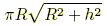
Surface area (total surface area) includes every outer face of a solid — the sides and the bases. Lateral surface area counts only the side faces, excluding the top and bottom bases. For a cylinder, for example, the lateral surface area is 2πRh, while the total surface area adds the two circular bases: 2πRh + 2πR².
What is the difference between surface area and volume?
Surface area measures the total area covering the outside of a 3D shape, expressed in square units (like cm²). Volume measures the space enclosed inside the shape, expressed in cubic units (like cm³). Think of surface area as the amount of wrapping paper needed and volume as how much the box can hold.
How do you find the surface area of a sphere?
Use the formula SA = 4πr², where r is the radius of the sphere. For instance, a sphere with radius 5 cm has surface area 4π(25) = 100π ≈ 314.16 cm². Note that a sphere has no separate base or lateral surface — its entire surface is one curved area.
Surface Area vs. Volume
Surface Area
Volume
What it measures
Total area of the outer surface of a solid
Amount of space enclosed inside a solid
Units
Square units (cm², m², ft²)
Cubic units (cm³, m³, ft³)
Box formula
2lw + 2lh + 2wh
lwh
Sphere formula
4πr²
(4/3)πr³
Real-world analogy
Amount of paint to cover the outside
Amount of water the shape can hold
Why It Matters
Surface area shows up whenever you need to know how much material covers the outside of an object — painting a room, wrapping a gift, or manufacturing a container. In science classes, surface area affects rates of heat transfer and chemical reactions. Standardized tests and geometry courses regularly ask you to compute and compare surface areas of prisms, cylinders, cones, and spheres.
Common Mistakes
Mistake: Confusing surface area with volume by using the wrong units or the wrong formula.
Correction: Surface area always uses square units (like cm²) because you are measuring area. Volume uses cubic units (like cm³). Double-check that your formula outputs an area, not a space measurement.
Mistake: Forgetting to include the base(s) when total surface area is required.
Correction: Lateral surface area covers only the sides. If a problem asks for total surface area, you must add the area of all bases. For a cylinder, that means adding 2πR² to the lateral area 2πRh.