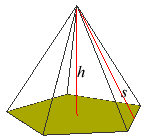
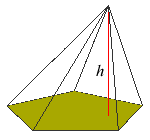
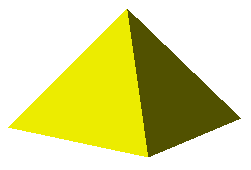
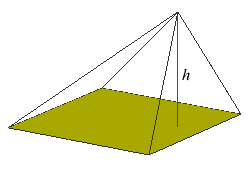
h = Height (perpendicular distance from base to apex)
L = Lateral surface area (for a right regular pyramid)
P = Perimeter of the base
s = Slant height (distance from base edge midpoint to apex along a lateral face)
T = Total surface area
Worked Example
Problem: A right regular pyramid has a square base with side length 6 cm and a height of 4 cm. Find its volume and total surface area.
Step 1: Find the area of the square base.
B=62=36 cm2
Step 2: Calculate the volume using the pyramid volume formula.
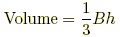
V=31Bh=31(36)(4)=48 cm3
Step 3: Find the slant height. The slant height runs from the midpoint of a base edge to the apex. The distance from the center of the square to the midpoint of a side is half the side length, which is 3 cm. Use the Pythagorean theorem with the pyramid's height.
s=h2+32=16+9=25=5 cm
Step 4: Find the perimeter of the base and then the lateral surface area.
P=4×6=24 cmL=21Ps=21(24)(5)=60 cm2
Step 5: Add the base area to get the total surface area.
T=L+B=60+36=96 cm2
Answer: The volume is 48 cm³ and the total surface area is 96 cm².
Another Example
This example uses a hexagonal base instead of a square base, showing that the volume formula V = (1/3)Bh works for any polygon — you just need to compute the appropriate base area.
Problem: A right regular pyramid has a regular hexagonal base with side length 4 m and a height of 9 m. Find its volume.
Step 1: Recall the area formula for a regular hexagon with side length a.
B=233a2
Step 2: Substitute a = 4 m to find the base area.
B=233(4)2=233(16)=243≈41.57 m2
Step 3: Apply the volume formula.
V=31Bh=31(243)(9)=723≈124.71 m3
Answer:The volume is 723≈124.71 m³.
Frequently Asked Questions
Why is the volume of a pyramid one-third the volume of a prism?
A pyramid with the same base and height as a prism occupies exactly one-third of the prism's space. One way to see this: a cube can be divided into three congruent square pyramids, each with volume (1/3)Bh. This relationship holds for any base shape, which is why the 1/3 factor always appears.
What is the difference between height and slant height of a pyramid?
The height (h) is the perpendicular distance from the apex straight down to the base plane. The slant height (s) is the distance measured along a lateral face from the midpoint of a base edge up to the apex. For a right regular pyramid, they are related by the Pythagorean theorem: s=h2+d2, where d is the distance from the center of the base to the midpoint of a base edge (the apothem of the base).
What is the difference between a right pyramid and an oblique pyramid?
In a right pyramid, the apex sits directly above the center of the base, so the height drops perpendicularly to the center. In an oblique pyramid, the apex is offset from the center, causing the pyramid to lean. The volume formula V=31Bh applies to both, but the lateral surface area formula L=21Ps only works for right regular pyramids because their lateral faces are congruent isosceles triangles.
Pyramid vs. Cone
Pyramid
Cone
Base shape
Polygon (triangle, square, pentagon, etc.)
Circle
Lateral surface
Flat triangular faces
Curved surface
Volume formula
V=31Bh where B is polygon area
V=31πr2h
Lateral area (right/regular)
L=21Ps
L=πrs
Classification
Polyhedron
Not a polyhedron (curved surface)
Why It Matters
Pyramids appear throughout geometry courses when you study three-dimensional solids, surface area, and volume. They show up in real-world contexts ranging from architecture (the Great Pyramid of Giza) to packaging design. Understanding pyramid formulas also prepares you for cones, since a cone is essentially a pyramid with a circular base — the volume formula has the same one-third structure.
Common Mistakes
Mistake: Forgetting the 1/3 factor and computing V = Bh instead of V = (1/3)Bh.
Correction: A pyramid's volume is always one-third of the corresponding prism. Always include the 1/3 in the formula.
Mistake: Confusing height and slant height when calculating surface area or volume.
Correction: The volume formula uses the perpendicular height h (apex straight down to the base). The lateral surface area formula uses the slant height s (along the face). If you are given one and need the other, use the Pythagorean theorem with the base's apothem.