
Cone
Cone
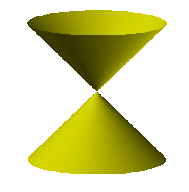
A three dimensional figure with a single base tapering to an apex. The base can be any simple closed curve. Often the word cone refers to a right circular cone.

See also
Right cone, oblique cone, circular cone, frustum of a cone or pyramid, height of a cone, volume, lateral surface, lateral surface area, surface area
Key Formula
V=31πr2handAtotal=πr2+πrl
Where:
- V = Volume of the cone
- r = Radius of the circular base
- h = Height (altitude) — the perpendicular distance from the base to the apex
- l = Slant height — the distance from any point on the edge of the base to the apex, where l = √(r² + h²)
- Atotal = Total surface area (base area plus lateral surface area)
- π = Pi, approximately 3.14159
Worked Example
Problem: A right circular cone has a base radius of 6 cm and a height of 8 cm. Find its volume and total surface area.
Step 1: Find the volume using the cone volume formula.
V=31πr2h=31π(6)2(8)=31π(288)=96π≈301.6 cm3
Step 2: Calculate the slant height using the Pythagorean theorem. The radius, height, and slant height form a right triangle.
l=r2+h2=62+82=36+64=100=10 cm
Step 3: Find the lateral (side) surface area.
Alateral=πrl=π(6)(10)=60π≈188.5 cm2
Step 4: Find the total surface area by adding the base area to the lateral area.
Atotal=πr2+πrl=36π+60π=96π≈301.6 cm2
Answer: The volume is 96π ≈ 301.6 cm³ and the total surface area is 96π ≈ 301.6 cm².
Another Example
This example works backward from a known volume to find a missing dimension, which is a common exam question and requires rearranging the formula.
Problem: A cone has a volume of 150π cm³ and a height of 18 cm. Find the radius of its base.
Step 1: Write the volume formula and substitute the known values.
150π=31πr2(18)
Step 2: Simplify the right side.
150π=6πr2
Step 3: Divide both sides by 6π to isolate r².
r2=6π150π=25
Step 4: Take the square root of both sides.
r=25=5 cm
Answer: The radius of the base is 5 cm.
Frequently Asked Questions
What is the difference between the height and the slant height of a cone?
The height (altitude) is the perpendicular distance measured straight down from the apex to the center of the base. The slant height is the distance measured along the surface of the cone from the apex to any point on the edge of the base. They are related by the Pythagorean theorem: l = √(r² + h²).
Why is the volume of a cone one-third the volume of a cylinder?
A cone with the same base radius and height as a cylinder fits inside it, and exactly three such cones would fill the cylinder. This can be proven rigorously using calculus (integration of cross-sectional areas), but it can also be demonstrated experimentally by filling a cone with water and pouring it into the matching cylinder — it takes exactly three cone-fulls.
What is the difference between a right cone and an oblique cone?
In a right cone, the apex sits directly above the center of the base, so the altitude is perpendicular to the base. In an oblique cone, the apex is offset to one side. The volume formula V = (1/3)πr²h works for both types, but the slant height is not uniform on an oblique cone, making surface area calculations more complex.
Cone vs. Cylinder
| Cone | Cylinder | |
|---|---|---|
| Shape | One circular base tapering to an apex | Two parallel circular bases of equal size |
| Volume | V = (1/3)πr²h | V = πr²h |
| Lateral surface area | πrl (where l is slant height) | 2πrh |
| Relationship | Exactly 1/3 the volume of the matching cylinder | Exactly 3 times the volume of the matching cone |
| Number of bases | 1 | 2 |
Why It Matters
Cones appear throughout geometry courses when you study three-dimensional figures, surface area, and volume. They also show up in real-world applications — ice cream cones, traffic cones, funnels, and conical tanks all require these formulas. In more advanced mathematics, conic sections (ellipses, parabolas, hyperbolas) are defined by slicing a double cone with a plane, connecting this shape to algebra and calculus.
Common Mistakes
Mistake: Forgetting the 1/3 factor in the volume formula and computing πr²h instead.
Correction: The volume of a cone is always one-third the volume of a cylinder with the same base and height. Write V = (1/3)πr²h and double-check that the fraction is included.
Mistake: Confusing height (h) with slant height (l) when calculating surface area or volume.
Correction: The volume formula uses the perpendicular height h, while the lateral surface area formula uses the slant height l. If you are given one, use l = √(r² + h²) to find the other before substituting.
Related Terms
- Right Circular Cone — Most common type of cone studied in geometry
- Volume — Key measurement calculated using the cone formula
- Lateral Surface Area — Area of the curved side surface of a cone
- Surface Area — Total area including base and lateral surface
- Frustum of a Cone or Pyramid — Shape formed by cutting off the top of a cone
- Altitude of a Cone — The perpendicular height from base to apex
- Oblique Cone — A cone whose apex is not centered over the base
- Double Cone — Two cones joined at their apexes, used in conic sections