
Volume by Parallel Cross Sections
Volume by Parallel Cross Sections
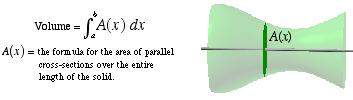
The formula below gives the volume of a solid. A(x) is the formula for the area of parallel cross-sections over the entire length of the solid.
Note: The disk method and the washer
method are both derived from this formula.
Movie clips (with narration)
 Volume by Parallel Cross-Sections: The Concept This can be a slow download. File size is 15.2M. |
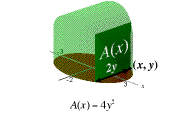 Volume by Parallel Cross-Sections: Example Squares on an Ellipse This can be a slow download. File size is 16.4M. |
Key Formula
V=∫abA(x)dx
Where:
- V = Volume of the solid
- A(x) = Area of the cross section at position x, taken perpendicular to the x-axis
- a = Left endpoint (starting x-value) of the solid
- b = Right endpoint (ending x-value) of the solid
- dx = An infinitesimally thin slice of width along the x-axis
Worked Example
Problem: A solid has its base in the xy-plane as the region between y = −x and y = x for 0 ≤ x ≤ 3. Cross sections perpendicular to the x-axis are squares. Find the volume of the solid.
Step 1: Determine the side length of each square cross section. At a given x, the base extends from y = −x to y = x, so the side length is the distance between these two curves.
s(x)=x−(−x)=2x
Step 2: Write the area of the square cross section as a function of x.
A(x)=[s(x)]2=(2x)2=4x2
Step 3: Set up the integral for the volume from x = 0 to x = 3.
V=∫034x2dx
Step 4: Evaluate the integral using the power rule.
V=4⋅3x303=34(27−0)=36
Answer: The volume of the solid is 36 cubic units.
Another Example
This example differs by using a circular (non-linear) base and equilateral triangle cross sections instead of squares, showing that the method works with any cross-sectional shape as long as you can express A(x).
Problem: A solid has a circular base given by x² + y² ≤ 9. Cross sections perpendicular to the x-axis are equilateral triangles. Find the volume of the solid.
Step 1: At position x, the circle extends from y = −√(9 − x²) to y = √(9 − x²). The side length of each equilateral triangle equals this chord length.
s(x)=29−x2
Step 2: The area of an equilateral triangle with side length s is (√3/4)s². Substitute the expression for s(x).
A(x)=43(29−x2)2=43⋅4(9−x2)=3(9−x2)
Step 3: Set up the integral over the full diameter of the circle, from x = −3 to x = 3.
V=∫−333(9−x2)dx
Step 4: Since the integrand is an even function, use symmetry to simplify the integral.
V=23∫03(9−x2)dx=23[9x−3x3]03
Step 5: Evaluate the expression at the bounds.
V=23(27−9)=23⋅18=363
Answer: The volume of the solid is 36√3 cubic units.
Frequently Asked Questions
What is the difference between the cross-section method and the disk/washer method?
The disk and washer methods are special cases of the cross-section method where the cross sections happen to be circles or annular rings (washers) because you are revolving a region around an axis. The general cross-section formula works for any shape of cross section — squares, triangles, semicircles, etc. — not just those produced by revolution.
How do you find A(x) for the cross-section formula?
First, identify the shape of each cross section (square, triangle, semicircle, etc.). Then, at a general position x, find the dimension that changes — usually the length of the base or diameter, determined by the boundary curves. Finally, plug that dimension into the standard area formula for that shape. For example, if cross sections are semicircles with diameter d(x), then A(x) = (π/8)[d(x)]².
When do you integrate with respect to y instead of x?
You integrate with respect to y when the cross sections are perpendicular to the y-axis rather than the x-axis. The formula becomes V = ∫ A(y) dy, and you express the cross-sectional area as a function of y. Choose whichever variable makes the cross-section area easier to write.
Volume by Parallel Cross Sections vs. Disk/Washer Method
| Volume by Parallel Cross Sections | Disk/Washer Method | |
|---|---|---|
| Cross-section shape | Any shape (square, triangle, semicircle, etc.) | Circles (disk) or annular rings (washer) |
| Formula | V = ∫ A(x) dx, where A(x) depends on the shape | V = π∫ [R(x)]² dx or π∫ ([R(x)]² − [r(x)]²) dx |
| When to use | When cross-sectional shape is given explicitly | When the solid is formed by revolving a region around an axis |
| Relationship | The general principle | A special case of the general cross-section method |
Why It Matters
This method is one of the first volume techniques you learn in AP Calculus and university-level integral calculus. It appears frequently on the AP Calculus AB/BC exams, often as a free-response question asking you to find the volume of a solid with square, triangular, or semicircular cross sections on a given base region. Mastering it also builds the foundation for the disk and washer methods, since those are derived directly from this idea.
Common Mistakes
Mistake: Using the side length instead of the area in the integral. For example, integrating s(x) = 2x instead of A(x) = (2x)² = 4x² for square cross sections.
Correction: Always convert the side length (or diameter, etc.) into the full area formula for the given cross-sectional shape before integrating. The integrand must be A(x), not s(x).
Mistake: Using incorrect limits of integration that don't match the extent of the solid along the axis of integration.
Correction: The limits a and b should be the x-values (or y-values) where the solid begins and ends. Find these by identifying where the boundary curves intersect or where the base region starts and stops along the chosen axis.
Related Terms
- Disk Method — Special case with circular cross sections
- Washer Method — Special case with annular ring cross sections
- Volume — The quantity this method computes
- Solid — The three-dimensional object being measured
- Parallel Planes — Cross sections lie in parallel planes
- Formula — The integral expression used in this method