
Sphere
Sphere
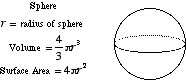
A three dimensional solid consisting of all points equidistant from a given point. This point is the center of the sphere. Note: All cross-sections of a sphere are circles.
See also
Key Formula
V=34πr3andSA=4πr2
Where:
- V = Volume of the sphere
- SA = Surface area of the sphere
- r = Radius — the distance from the center to any point on the sphere
- π = Pi, approximately 3.14159
Worked Example
Problem: A sphere has a radius of 6 cm. Find its volume and surface area.
Step 1: Write down the volume formula and substitute r = 6.
V=34πr3=34π(6)3
Step 2: Compute the cube of the radius.
63=216
Step 3: Multiply to find the volume.
V=34π⋅216=3864π=288π≈904.78 cm3
Step 4: Now use the surface area formula with r = 6.
SA=4πr2=4π(6)2=4π⋅36=144π≈452.39 cm2
Answer: The volume is 288π ≈ 904.78 cm³ and the surface area is 144π ≈ 452.39 cm².
Another Example
This example works backward from a given surface area to find the radius, then uses that radius to compute the volume — a common exam-style variation.
Problem: A basketball has a surface area of 1808.64 cm². Find its radius and volume. Use π ≈ 3.14.
Step 1: Start from the surface area formula and solve for r².
SA=4πr2⟹r2=4πSA=4(3.14)1808.64=12.561808.64
Step 2: Divide to find r².
r2=144⟹r=12 cm
Step 3: Now compute the volume using r = 12.
V=34πr3=34(3.14)(12)3=34(3.14)(1728)
Step 4: Evaluate the multiplication.
V=34×5426.88=321707.52=7238.23 cm3
Answer: The radius is 12 cm and the volume is approximately 7,238.23 cm³.
Frequently Asked Questions
What is the difference between a sphere and a circle?
A circle is a two-dimensional curve — the set of all points in a plane that are equidistant from a center. A sphere is its three-dimensional counterpart — the set of all points in space equidistant from a center. You can think of a sphere as a circle rotated around its diameter.
Why is there a 4/3 in the volume formula for a sphere?
The factor 4/3 comes from calculus — specifically from integrating the areas of infinitely many thin circular cross-sections stacked along a diameter. Without calculus, Archimedes proved it by showing that the volume of a sphere equals two-thirds the volume of the smallest cylinder that encloses it, which simplifies to (4/3)πr³.
How do you find the radius of a sphere from its volume?
Rearrange the volume formula: divide both sides by (4/3)π to isolate r³, then take the cube root. The formula becomes r = ∛(3V / 4π). For example, if V = 36π, then r³ = (3 · 36π) / (4π) = 27, so r = 3.
Sphere vs. Circle
| Sphere | Circle | |
|---|---|---|
| Dimensions | Three-dimensional (3D solid) | Two-dimensional (2D curve) |
| Key measurement | Volume: (4/3)πr³ | Area: πr² |
| Boundary measurement | Surface area: 4πr² | Circumference: 2πr |
| Cross-sections | Every cross-section is a circle | Not applicable (already 2D) |
| Real-world example | Basketball, globe, marble | Clock face, coin, wheel |
Why It Matters
Spheres appear throughout math and science courses — from geometry class volume problems to physics calculations involving planets, bubbles, and atoms. Understanding the sphere formulas is essential for standardized tests like the SAT and ACT, which regularly include sphere volume and surface area questions. Engineers and scientists rely on sphere geometry when designing tanks, calculating gravitational fields, and modeling cells in biology.
Common Mistakes
Mistake: Confusing the volume and surface area formulas — using 4πr² when volume is needed, or (4/3)πr³ when surface area is needed.
Correction: Remember that volume measures cubic space, so it must have r³ (cubed). Surface area measures a flat covering, so it uses r² (squared). A helpful mnemonic: Volume is the 'bigger' formula with the fraction 4/3 and the cube.
Mistake: Using the diameter instead of the radius in the formulas.
Correction: Both sphere formulas require the radius. If a problem gives the diameter d, divide by 2 first: r = d/2. Forgetting this step will make your answer off by a factor of 8 for volume or 4 for surface area.
Related Terms
- Volume — The measure of space inside a sphere
- Surface Area — The total area covering a sphere's outside
- Circle — The 2D analog of a sphere
- Three Dimensions — The space in which a sphere exists
- Solid — General category that includes spheres
- Equidistant — Key property defining a sphere's points
- Oblate Spheroid — A sphere flattened at the poles
- Prolate Spheroid — A sphere elongated along one axis