Regular Polygon
A polygon for which all sides are congruent and all angles are congruent.
See
also
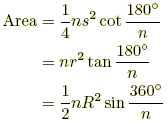
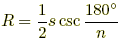
Area
of a regular polygon, cotangent, tangent,
sine, cosecant
Worked Example
Problem: Find each interior angle and the area of a regular hexagon with side length 10 cm and apothem approximately 8.66 cm.
Step 1: Identify the number of sides. A hexagon has 6 sides, so n = 6.
Step 2: Find the sum of interior angles using the formula.
Sum=(6−2)⋅180°=4⋅180°=720° Step 3: Divide by the number of angles to find each interior angle.
Each angle=6720°=120° Step 4: Calculate the area using A = (1/2)nsr, with s = 10 cm and r = 8.66 cm.
A=21⋅6⋅10⋅8.66=21⋅519.6=259.8 cm2 Answer: Each interior angle is 120°, and the area is approximately 259.8 cm².
Another Example
This example works backward from a known interior angle to find the number of sides, which is a common exam question and reverses the direction of the first example.
Problem: A regular polygon has interior angles that each measure 135°. How many sides does it have?
Step 1: Start with the interior angle formula and set it equal to 135°.
n(n−2)⋅180°=135° Step 2: Multiply both sides by n to clear the denominator.
(n−2)⋅180=135n Step 3: Expand the left side and solve for n.
180n−360=135n Step 4: Subtract 135n from both sides and solve.
45n=360⇒n=8 Answer: The polygon has 8 sides — it is a regular octagon.
Frequently Asked Questions
What is the difference between a regular and irregular polygon?
A regular polygon has all sides the same length AND all angles the same measure. An irregular polygon fails one or both of these conditions. For example, a rectangle has four equal angles (each 90°) but unless all four sides are also equal, it is irregular — only a square is a regular quadrilateral.
Is a circle a regular polygon?
No, a circle is not a polygon at all because it has no straight sides. However, as the number of sides of a regular polygon increases, its shape gets closer and closer to a circle. This limit relationship is useful in calculus and approximation problems.
How do you find the apothem of a regular polygon?
If you know the side length s and the number of sides n, the apothem is r=2tan(π/n)s. The apothem is the perpendicular distance from the center to the midpoint of any side. It equals the radius of the inscribed circle. Regular Polygon vs. Irregular Polygon
| Regular Polygon | Irregular Polygon |
|---|
| Definition | All sides congruent and all angles congruent | Sides and/or angles are not all congruent |
| Interior angle formula | Each angle = (n − 2)·180° / n | Angles vary; no single formula for each angle |
| Area formula | A = (1/2)nsr using the apothem | Requires other methods (triangulation, coordinates, etc.) |
| Symmetry | Has n lines of symmetry and rotational symmetry of order n | May have fewer or no lines of symmetry |
| Examples | Equilateral triangle, square, regular pentagon | Scalene triangle, rectangle (non-square), general quadrilateral |
Why It Matters
Regular polygons appear throughout geometry courses — from basic angle problems to tiling patterns and circle approximations. They are essential in real-world design and engineering, such as hexagonal bolts, octagonal stop signs, and tessellations in architecture. Many standardized math tests (SAT, ACT, GCSEs) include questions that require you to calculate interior angles or areas of regular polygons.
Common Mistakes
Mistake: Using (n − 2)·180° as the measure of a single interior angle instead of the sum.
Correction: The formula (n − 2)·180° gives the total sum of all interior angles. To find one angle in a regular polygon, you must divide by n: each angle = (n − 2)·180° / n.
Mistake: Assuming any polygon with equal sides is regular.
Correction: Equal sides alone are not sufficient. A rhombus has four equal sides but its angles are not all equal (unless it is a square), so it is not regular. Both conditions — congruent sides and congruent angles — must hold.





 Reference LibraryMathwords