
Triangle — Definition, Properties & Examples
Triangle
See also
Equilateral triangle, equiangular triangle, isosceles triangle, scalene triangle, right triangle, area of a triangle, base of a triangle, height of a triangle, semiperimeter, Heron's formula, inradius, incircle, circumcircle, trigonometry
Key Formula
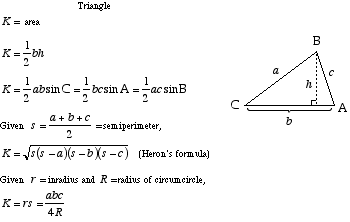
A=21bh
Where:
- A = Area of the triangle
- b = Length of the base (any one side)
- h = Height (perpendicular distance from the base to the opposite vertex)
Worked Example
Problem: A triangle has a base of 10 cm and a height of 6 cm. Find its area.
Step 1: Write the area formula for a triangle.
A=21bh
Step 2: Substitute the given base and height.
A=21×10×6
Step 3: Multiply the base by the height.
10×6=60
Step 4: Divide by 2 to get the area.
A=260=30 cm2
Answer: The area of the triangle is 30 cm².
Another Example
This example focuses on the angle sum property and perimeter rather than area, showing two other fundamental triangle calculations.
Problem: A triangle has angles of 50° and 65°. Find the third angle. Then, given that the triangle has sides of 7 cm, 8 cm, and 9 cm, find its perimeter.
Step 1: Use the angle sum property: the three interior angles of any triangle add up to 180°.
∠1+∠2+∠3=180°
Step 2: Substitute the two known angles and solve for the third.
50°+65°+∠3=180°⟹∠3=180°−115°=65°
Step 3: Find the perimeter by adding all three side lengths.
P=7+8+9=24 cm
Answer: The third angle is 65° and the perimeter is 24 cm.
Frequently Asked Questions
What are the different types of triangles?
Triangles are classified by sides or by angles. By sides: equilateral (all three sides equal), isosceles (exactly two sides equal), and scalene (no sides equal). By angles: acute (all angles less than 90°), right (one angle exactly 90°), and obtuse (one angle greater than 90°). A triangle can belong to one category from each group — for example, a right isosceles triangle.
Why do the angles of a triangle always add up to 180°?
This follows from the properties of parallel lines. If you draw a line through one vertex parallel to the opposite side, the three angles at that vertex form a straight line (180°). Alternate interior angles show that two of those angles equal the triangle's base angles. This proof works for every triangle in flat (Euclidean) geometry.
When do you use Heron's formula instead of the basic area formula?
Use Heron's formula when you know all three side lengths but do not know the height. It computes the area as A=s(s−a)(s−b)(s−c), where s is the semiperimeter. The basic formula A=21bh is simpler but requires the perpendicular height, which is not always given.
Triangle vs. Quadrilateral
| Triangle | Quadrilateral | |
|---|---|---|
| Number of sides | 3 | 4 |
| Angle sum | 180° | 360° |
| Basic area formula | A = ½ b h | Depends on the specific shape (rectangle, parallelogram, trapezoid, etc.) |
| Rigidity | Rigid — side lengths fix the shape | Not rigid — can flex even with fixed side lengths |
| Minimum polygon? | Yes — the simplest polygon | No — one step more complex |
Why It Matters
Triangles appear throughout mathematics, engineering, and science because any polygon can be divided into triangles — a process called triangulation. You will use triangle properties extensively in trigonometry, coordinate geometry, and physics (resolving forces into components). In construction and architecture, the triangle's rigidity makes it the most structurally stable shape, which is why you see it in bridges, roof trusses, and support braces.
Common Mistakes
Mistake: Using a slanted side length as the height instead of the perpendicular distance to the base.
Correction: The height must be measured at a right angle (90°) from the base to the opposite vertex. If you use a slanted side, your area calculation will be too large.
Mistake: Assuming the angle sum is 360° (confusing it with quadrilaterals).
Correction: The interior angles of a triangle always sum to exactly 180°, not 360°. A quick check: an equilateral triangle has three 60° angles, and 3 × 60° = 180°.
Related Terms
- Polygon — A triangle is the simplest polygon
- Area of a Triangle — Formula for computing a triangle's area
- Equilateral Triangle — Triangle with all three sides equal
- Isosceles Triangle — Triangle with exactly two equal sides
- Right Triangle — Triangle containing a 90° angle
- Altitude of a Triangle — Perpendicular height used in the area formula
- Heron's Formula — Finds area from three side lengths
- Trigonometry — Study of triangle angle-side relationships