
Sine — Definition, Formula & Examples
sine
sin
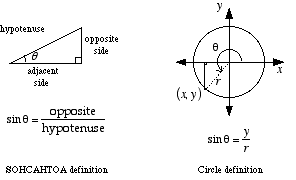
The trig function sine, written sin θ. For acute angles, sin θ can be found by the SOHCAHTOA definition as shown below on the left. The circle definition, a generalization of SOHCAHTOA, is shown below on the right. Finally, f(x) = sin x is a periodic function with period 2π.
See also
Key Formula
sinθ=hypotenuseopposite
Where:
- θ = The angle in a right triangle (or any angle when using the unit circle definition)
- opposite = The length of the side across from angle θ
- hypotenuse = The length of the longest side of the right triangle
Worked Example
Problem: In a right triangle, the side opposite angle θ has length 3 and the hypotenuse has length 5. Find sin θ.
Step 1: Identify the relevant sides. The opposite side is 3 and the hypotenuse is 5.
opposite=3,hypotenuse=5
Step 2: Apply the SOHCAHTOA definition of sine.
sinθ=hypotenuseopposite=53
Step 3: Express the result as a decimal if needed.
sinθ=0.6
Answer: sin θ = 3/5 = 0.6
Another Example
This example uses the unit circle definition to evaluate sine for a non-acute angle, showing how reference angles and quadrant signs extend SOHCAHTOA beyond right triangles.
Problem: Find the exact value of sin 150°.
Step 1: Determine the reference angle. Since 150° is in the second quadrant, the reference angle is 180° − 150° = 30°.
reference angle=180°−150°=30°
Step 2: Recall the exact value of sin 30°.
sin30°=21
Step 3: Determine the sign. Sine is positive in the second quadrant (y-coordinates are positive on the unit circle).
sin150°=+sin30°
Step 4: Write the final answer.
sin150°=21
Answer: sin 150° = 1/2
Frequently Asked Questions
What is the difference between sine, cosine, and tangent?
All three are ratios of sides in a right triangle. Sine is opposite over hypotenuse, cosine is adjacent over hypotenuse, and tangent is opposite over adjacent. They are related by the identity tan θ = sin θ / cos θ. Each function highlights a different pair of sides relative to the angle.
What is the range of the sine function?
The sine function outputs values only between −1 and 1, inclusive. Written in interval notation, the range is [−1, 1]. This is because on the unit circle, sin θ corresponds to the y-coordinate of a point, and no point on the unit circle has a y-coordinate outside that interval.
When is sine negative?
Sine is negative when the angle places its terminal side in the third or fourth quadrant, meaning 180° < θ < 360° (or equivalently π < θ < 2π in radians). In those quadrants the y-coordinate on the unit circle is below the x-axis, so the sine value is negative.
Sine vs. Cosine
| Sine | Cosine | |
|---|---|---|
| Definition | Ratio of the opposite side to the hypotenuse | Ratio of the adjacent side to the hypotenuse |
| Formula | sin θ = opposite / hypotenuse | cos θ = adjacent / hypotenuse |
| Unit circle interpretation | y-coordinate of the point on the unit circle | x-coordinate of the point on the unit circle |
| Value at 0° | 0 | 1 |
| Value at 90° | 1 | 0 |
| Graph shape | Sinusoidal wave starting at 0 | Sinusoidal wave starting at 1 (shifted left by π/2) |
Why It Matters
Sine appears throughout high school math and science — from solving right triangles in geometry to modeling oscillations in physics (sound waves, pendulums, alternating current). In precalculus and calculus, you use sine extensively when analyzing periodic functions, computing derivatives and integrals, and working with polar coordinates. Understanding sine is also essential for standardized tests such as the SAT and ACT, where right-triangle trigonometry is a core topic.
Common Mistakes
Mistake: Confusing the opposite and adjacent sides when computing sine.
Correction: The "opposite" side is always across from the angle you are evaluating — not the side next to it. Use the SOHCAHTOA mnemonic: Sine = Opposite / Hypotenuse. Label your triangle carefully before plugging in values.
Mistake: Using degree mode on a calculator when the problem gives radians, or vice versa.
Correction: Always check your calculator's angle mode. For example, sin(π/6) should equal 0.5. If your calculator returns −0.0027..., you are in degree mode and the calculator is interpreting π/6 ≈ 0.524 as 0.524°. Switch to radian mode.
Related Terms
- Trig Functions — Sine is one of the six trigonometric functions
- SOHCAHTOA — Mnemonic that defines sine for right triangles
- Circle Trig Definitions — Extends sine to all angles via the unit circle
- Inverse Sine — Finds the angle when the sine value is known
- Sinusoid — The wave-shaped graph produced by the sine function
- Periodic Function — Sine repeats every 2π, making it periodic
- Period of a Periodic Function — The period of sin x is 2π
- Acute Angle — SOHCAHTOA definition applies directly to acute angles