Mathwords logoReference LibraryMathwords

Period of a Periodic Function

Period of a Periodic Function

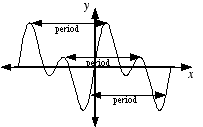
The horizontal distance required for the graph of a periodic function to complete one cycle. Formally, a function f is periodic if there exists a number p such that f(x + p) = f(x) for all x. The smallest possible value of p is the period. The reciprocal of period is frequency.


Graph of a periodic wave on x-y axes with three arrows each labeled "period" marking one complete cycle of the wave.


See also

Period of periodic motion

Key Formula

f(x+p)=f(x)for all xf(x + p) = f(x) \quad \text{for all } x
Where:
  • ff = A periodic function
  • xx = Any input value in the domain of f
  • pp = The period — the smallest positive number for which this equation holds

Worked Example

Problem: Find the period of the function f(x) = sin(3x).
Step 1: Recall that the standard sine function sin(x) has a period of 2π.
Period of sin(x)=2π\text{Period of } \sin(x) = 2\pi
Step 2: For a function of the form sin(Bx), the period is found by dividing the standard period by the absolute value of B.
Period=2πB\text{Period} = \frac{2\pi}{|B|}
Step 3: Here B = 3, so substitute into the formula.
Period=2π3=2π3\text{Period} = \frac{2\pi}{|3|} = \frac{2\pi}{3}
Step 4: Verify: check that f(x + 2π/3) = f(x). Since sin(3(x + 2π/3)) = sin(3x + 2π) = sin(3x), the result checks out.
sin ⁣(3 ⁣(x+2π3))=sin(3x+2π)=sin(3x)  \sin\!\left(3\!\left(x + \frac{2\pi}{3}\right)\right) = \sin(3x + 2\pi) = \sin(3x) \; \checkmark
Answer: The period of f(x) = sin(3x) is 2π/3.

Another Example

This example uses the tangent function, whose base period is π rather than 2π. It also involves a coefficient B less than 1, which stretches the period rather than compressing it.

Problem: Find the period of the function g(x) = tan(x/2).
Step 1: Recall that the standard tangent function tan(x) has a period of π (not 2π like sine and cosine).
Period of tan(x)=π\text{Period of } \tan(x) = \pi
Step 2: For a function of the form tan(Bx), the period is π divided by the absolute value of B.
Period=πB\text{Period} = \frac{\pi}{|B|}
Step 3: Here B = 1/2, so substitute into the formula.
Period=π1/2=π1/2=2π\text{Period} = \frac{\pi}{|1/2|} = \frac{\pi}{1/2} = 2\pi
Step 4: Verify: tan((x + 2π)/2) = tan(x/2 + π) = tan(x/2), since tangent repeats every π. The answer is confirmed.
tan ⁣(x+2π2)=tan ⁣(x2+π)=tan ⁣(x2)  \tan\!\left(\frac{x + 2\pi}{2}\right) = \tan\!\left(\frac{x}{2} + \pi\right) = \tan\!\left(\frac{x}{2}\right) \; \checkmark
Answer: The period of g(x) = tan(x/2) is 2π.

Frequently Asked Questions

How do you find the period of a trig function?
For sine and cosine functions of the form sin(Bx) or cos(Bx), divide 2π by the absolute value of B: period = 2π/|B|. For tangent and cotangent functions tan(Bx) or cot(Bx), divide π by |B| instead, since their base period is π. If the function includes vertical shifts or amplitude changes, those do not affect the period.
What is the difference between period and frequency?
Period and frequency are reciprocals of each other. The period tells you how long one complete cycle takes (measured in units along the x-axis), while the frequency tells you how many complete cycles occur per one unit. If the period is p, then the frequency is 1/p, and vice versa.
Can a function have more than one period?
Technically, if p is a period, then 2p, 3p, 4p, and so on also satisfy f(x + np) = f(x). However, when we refer to "the period," we always mean the smallest positive value of p. That unique smallest value is what distinguishes one cycle from repetitions of multiple cycles.

Period vs. Frequency

PeriodFrequency
DefinitionThe horizontal length of one complete cycleThe number of complete cycles per one horizontal unit
Formulap = 2π / |B| (for sin or cos)f = 1 / p = |B| / (2π)
Units (typical)Radians, seconds, or other x-axis unitsCycles per radian, Hertz (cycles per second)
Relationshipp = 1 / frequencyf = 1 / period
When to useWhen you need the duration or width of one cycleWhen you need how often cycles repeat in a given interval

Why It Matters

You encounter the period of a periodic function throughout trigonometry, precalculus, and physics. Modeling sound waves, tides, seasonal temperatures, and alternating current all depend on correctly identifying the period. On standardized tests and in calculus courses, recognizing how transformations like f(Bx) change the period is a frequently tested skill.

Common Mistakes

Mistake: Using 2π/B for tangent and cotangent functions.
Correction: The base period of tan(x) and cot(x) is π, not 2π. For tan(Bx), the correct period is π/|B|.
Mistake: Forgetting to take the absolute value of B when B is negative.
Correction: Period is always a positive quantity. A negative coefficient like B = −4 in sin(−4x) gives period 2π/|−4| = π/2, not a negative value. The negative sign reflects the graph but does not change the cycle length.

Related Terms