
Cotangent — Definition, Formula & Examples
cotangent
cot
ctg
The trig function cotangent,
written cot θ. cot θ equals  or
or  .
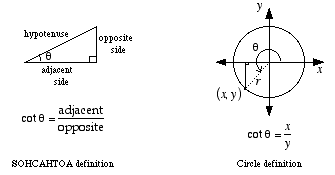
For acute angles, cot θ can
be found by the SOHCAHTOA definition,
shown below on the left. The
circle definition, a generalization
of SOHCAHTOA, is shown below on the right. f(x)
= cot x is
a periodic function with period π.
.
For acute angles, cot θ can
be found by the SOHCAHTOA definition,
shown below on the left. The
circle definition, a generalization
of SOHCAHTOA, is shown below on the right. f(x)
= cot x is
a periodic function with period π.
See also
Key Formula
cotθ=sinθcosθ=tanθ1=oppositeadjacent
Where:
- θ = The angle in question
- cosθ = The cosine of the angle
- sinθ = The sine of the angle (must not equal zero)
- adjacent = The side of a right triangle next to the angle (not the hypotenuse)
- opposite = The side of a right triangle across from the angle
Worked Example
Problem: In a right triangle, the side adjacent to angle θ has length 4 and the side opposite angle θ has length 3. Find cot θ.
Step 1: Recall the right-triangle definition of cotangent.
cotθ=oppositeadjacent
Step 2: Substitute the given side lengths.
cotθ=34
Step 3: Verify using tangent: tan θ = opposite/adjacent = 3/4, so cot θ = 1/tan θ = 4/3. The results agree.
cotθ=tanθ1=431=34
Answer: cot θ = 4/3
Another Example
This example uses an obtuse angle (beyond 90°) where the right-triangle definition doesn't directly apply, so we use the cos/sin ratio instead and must account for the sign based on the quadrant.
Problem: Find the exact value of cot 120°.
Step 1: Identify the reference angle. 120° is in the second quadrant, and its reference angle is 180° − 120° = 60°.
Reference angle=60°
Step 2: Recall the sine and cosine of 120°. In the second quadrant, sine is positive and cosine is negative.
sin120°=23,cos120°=−21
Step 3: Apply the formula cot θ = cos θ / sin θ.
cot120°=sin120°cos120°=23−21
Step 4: Simplify by dividing the fractions.
cot120°=−21×32=−31=−33
Answer: cot 120° = −√3/3
Frequently Asked Questions
What is the difference between cotangent and tangent?
Cotangent and tangent are reciprocals of each other. Tangent equals opposite over adjacent (or sin θ / cos θ), while cotangent equals adjacent over opposite (or cos θ / sin θ). Wherever tan θ is large, cot θ is small, and vice versa. Tangent is undefined when cos θ = 0, while cotangent is undefined when sin θ = 0.
When is cotangent undefined?
Cotangent is undefined whenever sin θ = 0, because cot θ = cos θ / sin θ and you cannot divide by zero. This occurs at θ = 0°, 180°, 360°, and in general at every integer multiple of π (i.e., θ = nπ where n is any integer).
What is the period of the cotangent function?
The cotangent function has a period of π (or 180°). This means cot θ = cot(θ + π) for all values of θ where cotangent is defined. Unlike sine and cosine, which have a period of 2π, cotangent repeats twice as often.
Cotangent (cot θ) vs. Tangent (tan θ)
| Cotangent (cot θ) | Tangent (tan θ) | |
|---|---|---|
| Definition | cos θ / sin θ, or adjacent / opposite | sin θ / cos θ, or opposite / adjacent |
| Reciprocal | Reciprocal of tangent: 1 / tan θ | Reciprocal of cotangent: 1 / cot θ |
| Undefined when | sin θ = 0 (at 0°, 180°, 360°, …) | cos θ = 0 (at 90°, 270°, …) |
| Period | π (180°) | π (180°) |
| Value at 45° | 1 | 1 |
| Behavior as angle increases from 0° to 90° | Decreases from +∞ to 0 | Increases from 0 to +∞ |
Why It Matters
Cotangent appears frequently in trigonometry courses, calculus (its derivative is −csc² x), and physics problems involving slopes or angular relationships. Many trigonometric identities involve cotangent, such as the Pythagorean identity 1 + cot² θ = csc² θ. You will also encounter it when simplifying expressions or solving equations where dividing by tangent is more convenient.
Common Mistakes
Mistake: Confusing cotangent with the inverse tangent (arctan or tan⁻¹).
Correction: Cotangent is the reciprocal of tangent: cot θ = 1/tan θ. The inverse tangent, tan⁻¹(x), is a completely different function that returns an angle given a ratio. They are not the same thing.
Mistake: Using the wrong ratio: writing cot θ = opposite/adjacent instead of adjacent/opposite.
Correction: Remember that cotangent flips the tangent ratio. Since tan θ = opposite/adjacent, cot θ = adjacent/opposite. A helpful mnemonic: cotangent 'co-' reverses the tangent ratio.
Related Terms
- Trig Functions — Cotangent is one of the six trig functions
- SOHCAHTOA — Mnemonic for right-triangle trig ratios
- Circle Trig Definitions — Generalizes cotangent to all angles via the unit circle
- Inverse Cotangent — The function that undoes cotangent (arccot)
- Periodic Function — Cotangent is periodic with period π
- Period of a Periodic Function — Describes the interval length before cot repeats
- Acute Angle — SOHCAHTOA definition applies to acute angles
- Angle — Cotangent takes an angle as its input