SOHCAHTOA
A way of remembering how to compute the sine,
cosine, and tangent of an angle.
SOH stands for Sine equals Opposite
over Hypotenuse.
CAH stands for Cosine equals Adjacent over Hypotenuse.
TOA stands for Tangent equals Opposite
over Adjacent.

| Example: |
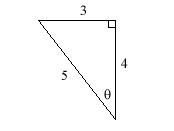
Find the values of sin θ, cos θ, and tan θ in the right triangle shown.
|
 |
| Answer: |
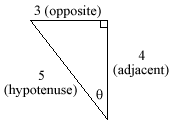
sin θ = 3/5 = 0.6
cosθ = 4/5 = 0.8
tanθ = 3/4 = 0.75 |
 |
| |
This triangle is oriented differently than the one shown in the SOHCAHTOA diagram, so make sure you know which sides are the opposite, adjacent, and hypotenuse.
|
Worked Example
Problem: In a right triangle, the side opposite angle θ is 5, the side adjacent to angle θ is 12, and the hypotenuse is 13. Find sin θ, cos θ, and tan θ.
Step 1: Identify the three sides relative to angle θ. Opposite = 5, Adjacent = 12, Hypotenuse = 13.
Step 2: Apply SOH — Sine equals Opposite over Hypotenuse.
sinθ=135≈0.3846 Step 3: Apply CAH — Cosine equals Adjacent over Hypotenuse.
cosθ=1312≈0.9231 Step 4: Apply TOA — Tangent equals Opposite over Adjacent.
tanθ=125≈0.4167 Answer: sin θ = 5/13 ≈ 0.385, cos θ = 12/13 ≈ 0.923, tan θ = 5/12 ≈ 0.417
Another Example
This example uses SOHCAHTOA to find an unknown side length rather than computing a ratio from known sides. It shows how to pick the correct ratio (SOH) based on the given and unknown quantities.
Problem: A ladder leans against a wall, forming a right triangle with the ground. The angle between the ladder and the ground is 40°. If the ladder (hypotenuse) is 10 metres long, how high up the wall does it reach?
Step 1: Draw the situation. The angle θ = 40° is between the ladder and the ground. The wall height is the side opposite the 40° angle, and the ladder is the hypotenuse.
Step 2: Choose the right ratio. You know the hypotenuse and want the opposite side, so use SOH: sin θ = Opposite / Hypotenuse.
sin40°=10height Step 3: Solve for the height by multiplying both sides by 10.
height=10×sin40° Step 4: Use a calculator: sin 40° ≈ 0.6428.
height≈10×0.6428=6.428 m Answer: The ladder reaches approximately 6.43 metres up the wall.
Frequently Asked Questions
How do you remember which ratio is SOH, CAH, or TOA?
Read the mnemonic as three chunks: SOH, CAH, TOA. In each chunk, the first letter is the trig function (Sin, Cos, Tan), the second letter is the numerator (Opposite or Adjacent), and the third letter is the denominator (Hypotenuse or Adjacent). Some students remember the phrase 'Some Old Houses Can Always Hide Their Old Age' where the first letters match S-O-H-C-A-H-T-O-A.
Does SOHCAHTOA work for any triangle?
No. SOHCAHTOA applies only to right triangles, because the definitions of opposite, adjacent, and hypotenuse require a 90° angle. For non-right triangles, you need the Law of Sines or the Law of Cosines instead.
How do you decide which SOHCAHTOA ratio to use?
Look at what you know and what you need. If a problem involves the opposite side and the hypotenuse, use SOH (sine). If it involves the adjacent side and the hypotenuse, use CAH (cosine). If it involves the opposite and adjacent sides, use TOA (tangent). Pick the ratio that connects your known value to the unknown.
SOHCAHTOA (basic trig ratios) vs. Law of Sines / Law of Cosines
| SOHCAHTOA (basic trig ratios) | Law of Sines / Law of Cosines |
|---|
| Triangle type | Right triangles only | Any triangle (including non-right) |
| What you need | One acute angle and two sides of a right triangle | Various combinations of sides and angles in any triangle |
| Typical use | Finding a missing side or angle when a 90° angle is present | Solving triangles that have no right angle |
| Formulas | sin = O/H, cos = A/H, tan = O/A | a/sin A = b/sin B; c² = a² + b² − 2ab cos C |
Why It Matters
SOHCAHTOA is one of the first tools you learn in trigonometry and appears constantly in geometry, physics, and engineering courses. Problems involving heights, distances, slopes, and angles of elevation almost always start with these three ratios. Mastering SOHCAHTOA also builds the foundation for the unit circle, inverse trig functions, and more advanced identities you will encounter later.
Common Mistakes
Mistake: Mixing up the opposite and adjacent sides when the triangle is rotated or drawn in an unusual orientation.
Correction: Always identify sides relative to the specific angle θ you are working with. The opposite side is directly across from θ, the adjacent side touches θ (and is not the hypotenuse), and the hypotenuse is always opposite the right angle.
Mistake: Using SOHCAHTOA on a triangle that has no right angle.
Correction: These ratios are defined only for right triangles. If no 90° angle is present, use the Law of Sines or Law of Cosines instead.
