
Conic Sections
Conic Sections
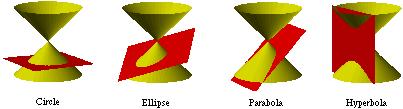
The family of curves including circles, ellipses, parabolas, and hyperbolas. All of these geometric figures may be obtained by the intersection a double cone with a plane, hence the name conic section. All conic sections have equations of the form Ax2 + Bxy + Cy2 + Dx + Ey + F = 0.
See also
Key Formula
Ax2+Bxy+Cy2+Dx+Ey+F=0
Where:
- A,B,C = Coefficients of the second-degree terms; their values determine which type of conic the equation represents
- D,E = Coefficients of the first-degree (linear) terms in x and y
- F = The constant term
- x,y = Coordinates of any point on the conic
Worked Example
Problem: Identify the conic section given by the equation 4x² + 4y² − 16x + 24y − 36 = 0 and write it in standard form.
Step 1: Group the x-terms and y-terms together and move the constant to the right side.
4x2−16x+4y2+24y=36
Step 2: Factor out the leading coefficient (4) from both groups.
4(x2−4x)+4(y2+6y)=36
Step 3: Complete the square inside each set of parentheses. For x: half of −4 is −2, squared is 4. For y: half of 6 is 3, squared is 9. Add the corresponding amounts to the right side.
4(x2−4x+4)+4(y2+6y+9)=36+16+36
Step 4: Rewrite as perfect squares and simplify the right side.
4(x−2)2+4(y+3)2=88
Step 5: Divide both sides by 4 to obtain standard form.
(x−2)2+(y+3)2=22
Answer: The equation represents a circle with center (2, −3) and radius √22. Because A = C = 4 and B = 0, the conic is a circle.
Another Example
This example uses the discriminant shortcut to classify a conic directly from its general equation, without completing the square or converting to standard form — useful when the equation contains an xy-term.
Problem: Use the discriminant B² − 4AC to classify the conic section 3x² + 5xy − 2y² + 7x − 4y + 10 = 0 without rewriting it.
Step 1: Identify the coefficients of the second-degree terms from the general equation.
A=3,B=5,C=−2
Step 2: Compute the discriminant B² − 4AC.
B2−4AC=52−4(3)(−2)=25+24=49
Step 3: Apply the classification rule: if B² − 4AC > 0, the conic is a hyperbola; if = 0, a parabola; if < 0, an ellipse (or circle).
49>0⟹hyperbola
Answer: The equation represents a hyperbola because the discriminant equals 49, which is positive.
Frequently Asked Questions
How do you tell which conic section an equation represents?
Compute the discriminant B² − 4AC from the general second-degree equation. If B² − 4AC < 0 and A = C with B = 0, it is a circle. If B² − 4AC < 0 otherwise, it is an ellipse. If B² − 4AC = 0, it is a parabola. If B² − 4AC > 0, it is a hyperbola.
Why are they called conic sections?
They are called conic sections because each curve can be produced by slicing a double cone (two identical cones joined tip-to-tip) with a flat plane. The angle of the cutting plane relative to the cone's axis determines whether the resulting cross-section is a circle, ellipse, parabola, or hyperbola.
What is the difference between an ellipse and a circle in conic sections?
A circle is actually a special case of an ellipse where both axes have equal length, meaning the eccentricity is 0. An ellipse has eccentricity between 0 and 1, so one axis is longer than the other. In the general equation, a circle has A = C and B = 0, while an ellipse has A ≠ C (with B² − 4AC < 0).
Ellipse vs. Hyperbola
| Ellipse | Hyperbola | |
|---|---|---|
| Definition | Closed oval curve; set of points where the sum of distances to two foci is constant | Open two-branched curve; set of points where the difference of distances to two foci is constant |
| Standard form | a2(x−h)2+b2(y−k)2=1 | a2(x−h)2−b2(y−k)2=1 |
| Eccentricity | 0 < e < 1 | e > 1 |
| Discriminant B² − 4AC | Negative (< 0) | Positive (> 0) |
| Shape | Closed curve (bounded) | Two separate open branches (unbounded) |
Why It Matters
Conic sections appear throughout algebra II, precalculus, and calculus courses as a core topic for graphing and equation analysis. They also model real-world phenomena: planetary orbits are ellipses, satellite dishes and headlight reflectors use parabolas, and hyperbolas describe the paths of certain comets. Understanding the general equation lets you classify and graph any conic quickly on exams and standardized tests.
Common Mistakes
Mistake: Confusing the signs in the standard forms of an ellipse and a hyperbola — writing a minus sign for an ellipse or a plus sign for a hyperbola.
Correction: Remember: an ellipse uses addition between its two fraction terms (both positive), while a hyperbola uses subtraction (one term is negative). The sign directly determines whether the curve is closed or open.
Mistake: Forgetting to multiply the completed-square constant by the factored-out coefficient when completing the square.
Correction: If you factor out a coefficient k before completing the square, you must add k times the square-completion constant to both sides. For example, factoring out 4 and adding 9 inside the parentheses means adding 4 × 9 = 36 to the right side.
Related Terms
- Circle — Conic with eccentricity 0 (special ellipse)
- Ellipse — Conic with eccentricity between 0 and 1
- Parabola — Conic with eccentricity exactly 1
- Hyperbola — Conic with eccentricity greater than 1
- Eccentricity — Parameter that classifies conic type
- Double Cone — 3D surface sliced to produce conics
- Degenerate Conic Sections — Special cases like a point, line, or crossed lines
- Focal Radius — Distance from a focus to a point on the conic