Parabola
A u-shaped curve with certain specific properties.
Formally, a parabola is defined as follows: For a given point,
called the focus, and a given line not through the focus, called
the directrix, a parabola is the locus of points such that the
distance to the focus equals the distance to the directrix.
Note:
It is a common error to call any u-shaped curve a parabola. A
parabola must satisfy the conditions listed above, and a parabola
always
has a quadratic equation.
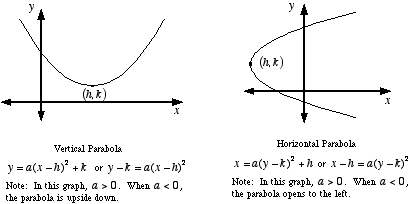


See
also
Area
of a parabolic segment, focal radius
Worked Example
Problem: Find the vertex, axis of symmetry, focus, and directrix of the parabola y=2x2−8x+6. Step 1: Rewrite in vertex form by completing the square. Factor the leading coefficient from the first two terms.
y=2(x2−4x)+6 Step 2: Complete the square inside the parentheses. Half of −4 is −2, and (−2)2=4. Add and subtract 4 inside.y=2(x2−4x+4−4)+6=2(x−2)2−8+6=2(x−2)2−2 Step 3: Read off the vertex from the vertex form y=2(x−2)2−2.Vertex=(h,k)=(2,−2) Step 4: The axis of symmetry is the vertical line through the vertex.
Step 5: For a vertical parabola in the form y=a(x−h)2+k, the focus is at (h,k+4a1) and the directrix is y=k−4a1. Here a=2, so 4a1=81.Focus=(2,−2+81)=(2,−815),Directrix: y=−2−81=−817 Answer: Vertex (2,−2), axis of symmetry x=2, focus (2,−815), directrix y=−817. Another Example
This example starts from the geometric definition (focus and directrix) instead of an algebraic equation, showing how to build the equation from the parabola's defining features.
Problem: A parabola has its focus at (0,3) and its directrix at y=−3. Write its equation. Step 1: The vertex is the midpoint between the focus and the directrix. The focus is at y=3 and the directrix is y=−3, so the vertex is at y=0.Vertex=(0,23+(−3))=(0,0) Step 2: The distance from the vertex to the focus is p=3. Since the focus is above the vertex, the parabola opens upward. Step 3: Use the standard form x2=4py for a parabola with vertex at the origin opening upward.x2=4(3)y=12y Step 4: Solve for y to write it in the more familiar form.y=12x2 Answer: The equation is x2=12y, or equivalently y=12x2. Frequently Asked Questions
What is the difference between a parabola and a hyperbola?
A parabola is a single U-shaped curve produced by slicing a cone parallel to its side; it has one branch and one focus. A hyperbola consists of two separate branches and has two foci. Algebraically, a parabola comes from a quadratic equation in one variable, while a hyperbola involves two squared variables with opposite signs, such as a2x2−b2y2=1. How do you find the focus of a parabola from its equation?
First convert the equation to vertex form y=a(x−h)2+k. The focus lies on the axis of symmetry at a distance 4a1 from the vertex. For an upward- or downward-opening parabola, the focus is at (h,k+4a1). If a>0 the focus is above the vertex; if a<0 it is below. Is every U-shaped curve a parabola?
No. A curve is a parabola only if every point on it is equidistant from a fixed focus and a fixed directrix, which produces a quadratic equation. Many U-shaped curves — such as catenaries (the shape of a hanging chain) or the curves y=x4 — look similar but are not parabolas. Parabola vs. Circle
| Parabola | Circle |
|---|
| Definition | Set of points equidistant from a focus and a directrix | Set of points equidistant from a single center point |
| Equation form | y=ax2+bx+c (one squared variable) | (x−h)2+(y−k)2=r2 (two squared variables, same coefficient) |
| Conic section type | Eccentricity e=1; slice parallel to cone's side | Eccentricity e=0; slice perpendicular to cone's axis |
| Shape | Open curve extending to infinity | Closed curve |
| Key features | Vertex, focus, directrix, axis of symmetry | Center, radius |
Why It Matters
Parabolas appear throughout algebra, precalculus, and physics. You use them when graphing quadratic functions, solving projectile motion problems (the path of a thrown ball is a parabola), and analyzing satellite dishes or headlight reflectors that rely on the parabola's reflective property. Mastering the vertex form and focus–directrix relationship is essential for standardized tests and for understanding conic sections in later courses.
Common Mistakes
Mistake: Calling any U-shaped curve a parabola.
Correction: A true parabola must satisfy the focus–directrix distance condition and have a quadratic equation. Curves like y=x4, y=∣x∣, or a catenary are U-shaped but are not parabolas. Mistake: Confusing the sign of a with the direction the parabola opens. Correction: When a>0 the parabola opens upward (vertex is a minimum). When a<0 it opens downward (vertex is a maximum). Students sometimes reverse this or forget it applies only to parabolas written with y isolated. 

 with all its major features labeled: