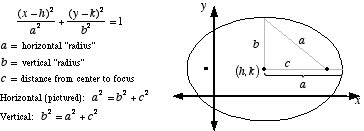
Formally, an ellipse can be defined as follows: For two
given points, the foci, an ellipse is the locus of points such
that the sum of the distance to each focus is constant. The standard
form for the equation of an ellipse is given below.
a = The semi-major axis length (half the longest diameter)
b = The semi-minor axis length (half the shortest diameter)
c = The distance from the center to each focus, found by c² = a² − b² (where a > b)
Worked Example
Problem: Find the foci, vertices, and lengths of the axes for the ellipse given by (x − 1)²/25 + (y + 2)²/9 = 1.
Step 1: Identify the center (h, k) and the values of a² and b² from the equation.
h=1,k=−2,a2=25,b2=9
Step 2: Find a and b by taking square roots. Since a² > b², the major axis is horizontal.
a=5,b=3
Step 3: Calculate c using the relationship c² = a² − b².
c2=25−9=16⟹c=4
Step 4: Locate the foci. Because the major axis is horizontal, the foci lie at (h ± c, k).
(1±4,−2)⟹(−3,−2) and (5,−2)
Step 5: State the vertices (endpoints of the major axis) and axis lengths.
Vertices: (−4,−2) and (6,−2)
Answer: Center (1, −2); foci (−3, −2) and (5, −2); vertices (−4, −2) and (6, −2); major axis length = 10, minor axis length = 6.
Another Example
This example starts from a general-form equation and shows how to convert it to standard form, rather than analyzing an equation already in standard form.
Problem: Write the equation of the ellipse in standard form given the equation 4x² + 9y² = 36.
Step 1: Divide every term by 36 so the right side equals 1.
364x2+369y2=1⟹9x2+4y2=1
Step 2: Identify a² and b². Here a² = 9 and b² = 4, so a = 3 and b = 2. The center is (0, 0).
a=3,b=2
Step 3: Find c to locate the foci.
c=a2−b2=9−4=5≈2.24
Step 4: Since the larger denominator is under x², the major axis is horizontal. The foci are at (±√5, 0). The area of the ellipse is πab.
A=π(3)(2)=6π≈18.85
Answer: Standard form: x²/9 + y²/4 = 1, with center (0, 0), foci (±√5, 0), and area 6π.
Frequently Asked Questions
What is the difference between an ellipse and a circle?
A circle is a special case of an ellipse where both semi-axes are equal (a = b), so it has only one center point rather than two foci. In an ellipse, a ≠ b, which makes it elongated in one direction. The equation of a circle uses a single radius r², while an ellipse uses two different denominators a² and b².
How do you find the foci of an ellipse?
Use the formula c² = a² − b², where a is the larger semi-axis and b is the smaller one. Take the square root to get c. The foci are located at distance c from the center along the major axis: at (h ± c, k) if the major axis is horizontal, or at (h, k ± c) if it is vertical.
What is the eccentricity of an ellipse?
Eccentricity is e = c/a, where c is the distance from the center to a focus and a is the semi-major axis. It measures how "stretched" the ellipse is. An eccentricity of 0 gives a perfect circle, while values approaching 1 produce a very elongated, nearly flat ellipse.
Ellipse vs. Hyperbola
Ellipse
Hyperbola
Definition
Set of points where the sum of distances to two foci is constant
Set of points where the absolute difference of distances to two foci is constant
Standard form
x²/a² + y²/b² = 1 (addition)
x²/a² − y²/b² = 1 (subtraction)
Shape
Closed, oval curve
Two separate open branches
Relationship of a, b, c
c² = a² − b²
c² = a² + b²
Eccentricity
0 < e < 1
e > 1
Why It Matters
Ellipses appear throughout science and mathematics. Kepler's first law states that every planet orbits the Sun in an elliptical path with the Sun at one focus, making ellipses essential in astronomy and physics. You also encounter ellipses in precalculus and calculus courses when studying conic sections, and in engineering applications such as satellite dish design, whispering galleries, and optics.
Common Mistakes
Mistake: Confusing a² and b² — assuming a² is always under x².
Correction: The value a always represents the larger semi-axis. If the larger denominator is under y², the major axis is vertical, not horizontal. Always compare the two denominators first to determine the orientation.
Mistake: Using c² = a² + b² instead of c² = a² − b² when finding the foci.
Correction: The formula c² = a² + b² applies to hyperbolas, not ellipses. For an ellipse, the foci lie inside the curve, so c must be less than a, which requires subtraction: c² = a² − b².
Related Terms
Conic Sections — Ellipse is one of the four conic sections