
Vertices of an Ellipse
Vertices of an Ellipse
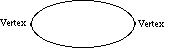
The points at which an ellipse makes its sharpest turns. The vertices are on the major axis (the line through the foci).
See also
Vertex, directrices of an ellipse, vertices of a hyperbola, vertex of a parabola
Key Formula
For a2x2+b2y2=1 with a>b:Vertices=(±a,0)
For b2x2+a2y2=1 with a>b:Vertices=(0,±a)
Where:
- a = The semi-major axis length — the distance from the center to each vertex. This is always the larger of the two denominators' square roots.
- b = The semi-minor axis length — the distance from the center to each co-vertex.
- (h,k) = If the ellipse is centered at (h, k) instead of the origin, the vertices shift to (h ± a, k) for a horizontal major axis or (h, k ± a) for a vertical major axis.
Worked Example
Problem: Find the vertices of the ellipse given by the equation x²/25 + y²/9 = 1.
Step 1: Identify a² and b² from the standard form. The equation is already in the form x²/a² + y²/b² = 1.
a2=25,b2=9
Step 2: Take the square roots to find a and b.
a=5,b=3
Step 3: Since a² = 25 is under x², the major axis is horizontal (along the x-axis). The vertices lie at (±a, 0).
Vertices=(±5,0)
Step 4: Write the two vertex points explicitly.
(5,0)and(−5,0)
Answer: The vertices are (5, 0) and (−5, 0).
Another Example
This example differs because the ellipse is not centered at the origin and has a vertical major axis, requiring you to apply the center offset (h, k) and recognize which denominator corresponds to a².
Problem: Find the vertices of the ellipse (x − 3)²/16 + (y + 2)²/49 = 1.
Step 1: Identify the center (h, k) from the equation.
h=3,k=−2⇒Center=(3,−2)
Step 2: Identify a² and b². The larger denominator determines a².
a2=49,b2=16⇒a=7,b=4
Step 3: Since a² = 49 is under the y-term, the major axis is vertical. The vertices are at (h, k ± a).
Vertices=(3,−2±7)
Step 4: Compute the two vertex coordinates.
(3,−2+7)=(3,5)and(3,−2−7)=(3,−9)
Answer: The vertices are (3, 5) and (3, −9).
Frequently Asked Questions
What is the difference between vertices and co-vertices of an ellipse?
Vertices are the endpoints of the major axis (the longer axis), located at distance a from the center. Co-vertices are the endpoints of the minor axis (the shorter axis), located at distance b from the center. Since a > b, the vertices are always farther from the center than the co-vertices.
How do you find the vertices of an ellipse from its equation?
First, write the equation in standard form. Identify which denominator is larger — that value is a². Take its square root to get a. If a² is under the x-term, the vertices are at (h ± a, k). If a² is under the y-term, the vertices are at (h, k ± a), where (h, k) is the center.
How many vertices does an ellipse have?
An ellipse has exactly two vertices. These are the two points at opposite ends of the major axis. Some textbooks also refer to the co-vertices (endpoints of the minor axis) as additional special points, giving four total named endpoints, but the term 'vertices' specifically refers to the two on the major axis.
Vertices of an Ellipse vs. Foci of an Ellipse
| Vertices of an Ellipse | Foci of an Ellipse | |
|---|---|---|
| Definition | The two points where the ellipse intersects its major axis | The two interior points such that the sum of distances from any point on the ellipse to the foci is constant |
| Location | On the ellipse itself, at the endpoints of the major axis | Inside the ellipse, along the major axis |
| Distance from center | a (the semi-major axis length) | c, where c² = a² − b² |
| Relationship | Vertices are always farther from the center than foci (a > c) | Foci are always between the center and the vertices |
Why It Matters
You encounter vertices of an ellipse in precalculus and conic sections courses, where identifying key features of an ellipse from its equation is a standard skill. Vertices also appear in physics when studying planetary orbits — the vertices of an orbital ellipse correspond to the closest approach (perihelion) and farthest point (aphelion) from the central body. Being able to quickly locate the vertices helps you sketch an accurate graph and solve problems about the ellipse's dimensions and eccentricity.
Common Mistakes
Mistake: Confusing a² with b² by always assigning a² to the x-term.
Correction: The value a² is always the larger denominator, regardless of whether it is under x² or y². If the larger denominator is under y², the major axis is vertical, not horizontal.
Mistake: Forgetting to add the center coordinates when the ellipse is not at the origin.
Correction: For an ellipse centered at (h, k), the vertices are at (h ± a, k) or (h, k ± a), not at (±a, 0) or (0, ±a). Always account for the shift.
Related Terms
- Ellipse — The conic section whose vertices are defined
- Major Axis of an Ellipse — The axis on which the vertices lie
- Foci of an Ellipse — Interior points on the major axis between center and vertices
- Directrices of an Ellipse — Lines outside the ellipse related to eccentricity
- Vertex — General term for a turning point on a curve
- Vertices of a Hyperbola — Analogous concept for a hyperbola
- Vertex of a Parabola — Analogous concept for a parabola
- Point — Each vertex is a specific point in the plane