Mathwords logoReference LibraryMathwords

Trig Identities

Trig Identities

Identities involving trig functions are listed below.


Pythagorean Identities

sin2 θ + cos2 θ = 1

tan2 θ + 1 = sec2 θ

cot2 θ + 1 = csc2 θ

Reciprocal Identities

Reciprocal identity formula: sin x = 1 divided by csc x

Math formula showing csc x equals 1 divided by sin x, a reciprocal identity for cosecant.

Reciprocal identity formula: cos x = 1 divided by sec x Reciprocal identity formula: sec x = 1 divided by cos x
tan x = 1 divided by cot x, showing tangent as the reciprocal of cotangent Reciprocal identity formula: cot x equals 1 divided by tan x

Ratio Identities

Ratio identity formula: tan x equals sin x divided by cos x

Ratio identity formula: cot x equals cos x divided by sin x


Odd/Even Identities

sin (–x) = –sin x

cos (–x) = cos x

tan (–x) = –tan x

csc (–x) = –csc x

sec (–x) = sec x

cot (–x) = –cot x


Cofunction Identities, radians

  Cofunction Identities, degrees
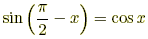
sin(π/2 − x) = cos x cos(π/2 − x) = sin x  

sin (90° – x) = cos x

cos (90° – x) = sin x

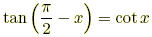
Math equation showing the cofunction identity: tan(π/2 − x) = cot x Cofunction identity formula: cot(π/2 − x) = tan x   tan (90° – x) = cot x cot (90° – x) = tan x
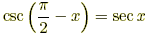
sec(π/2 − x) = csc x Cofunction identity formula: csc(π/2 − x) = sec x   sec (90° – x) = csc x csc (90° – x) = sec x


Periodicity Identities, radians

  Periodicity Identities, degrees

sin (x + 2π) = sin x

csc (x + 2π) = csc x


sin (x + 360°) = sin x

csc (x + 360°) = csc x

cos (x + 2π) = cos x

sec (x + 2π) = sec x


cos (x + 360°) = cos x

sec (x + 360°) = sec x

tan (x + π) = tan x

cot (x + π) = cot x


tan (x + 180°) = tan x

cot (x + 180°) = cot x


Sum/Difference Identities

Two sine sum/difference identities: sin(x+y)=sin x cos y+cos x sin y; sin(x−y)=sin x cos y−cos x sin y

Two cosine sum/difference identities: cos(x+y)=cosx·cosy−sinx·siny and cos(x−y)=cosx·cosy+sinx·siny

Two tangent sum/difference identities: tan(x+y)=(tan x+tan y)/(1−tan x tan y); tan(x−y)=(tan x−tan y)/(1+tan x tan y)


Double Angle Identities

Math formula: sin 2x = 2 sin x cos x, the double angle identity for sine.

cos 2x equals three equivalent forms: cos²x − sin²x, 1 − 2sin²x, and 2cos²x − 1

tan(2x) = (2·tan x) / (1 − tan²x)


Half Angle Identities

Half angle identity formula: sin(x/2) = ±√((1 − cos x)/2)  or  Formula: sin²x = (1 − cos 2x) / 2, a half angle identity for sine squared.

cos(x/2) = ±√((1 + cos x) / 2)  or  cos²x = (1 + cos 2x) / 2, a half angle identity for cosine squared

tan(x/2) = ± sqrt((1 − cos x) / (1 + cos x))  or  Math formula: sin(x) divided by (1 + cos x)  or  (1 - cos x) / sin x


Product to Sum Identities

cos x cos y = (1/2)[cos(x + y) + cos(x − y)]

Formula: sin x sin y = (1/2)[cos(x − y) − cos(x + y)]

sin x cos y = 1/2 [sin(x + y) + sin(x - y)]


Sum to Product Identities

sin x + sin y = 2 sin((x+y)/2) cos((x-y)/2)

sin x minus sin y equals 2 cos((x+y)/2) times sin((x-y)/2)

cos x + cos y = 2cos((x+y)/2)cos((x-y)/2)

cos x minus cos y equals negative 2 times sin((x+y)/2) times sin((x-y)/2)


See also

Sine, cosine, tangent, cosecant, secant, cotangent

Key Formula

sin2θ+cos2θ=1tan2θ+1=sec2θcot2θ+1=csc2θsin(A±B)=sinAcosB±cosAsinBcos(A±B)=cosAcosBsinAsinBsin(2θ)=2sinθcosθcos(2θ)=cos2θsin2θ\begin{gathered}\sin^2\theta + \cos^2\theta = 1\\\tan^2\theta + 1 = \sec^2\theta\\\cot^2\theta + 1 = \csc^2\theta\\\sin(A \pm B) = \sin A\cos B \pm \cos A\sin B\\\cos(A \pm B) = \cos A\cos B \mp \sin A\sin B\\\sin(2\theta) = 2\sin\theta\cos\theta\\\cos(2\theta) = \cos^2\theta - \sin^2\theta\end{gathered}
Where:
  • θ\theta = Any angle (in degrees or radians)
  • A,BA, B = Angles used in sum/difference and related identities

Worked Example

Problem: Simplify the expression sin2x+sin2xtan2x\sin^2 x + \sin^2 x \tan^2 x.
Step 1: Factor out the common factor sin2x\sin^2 x.
sin2x+sin2xtan2x=sin2x(1+tan2x)\sin^2 x + \sin^2 x\tan^2 x = \sin^2 x\,(1 + \tan^2 x)
Step 2: Apply the Pythagorean identity 1+tan2x=sec2x1 + \tan^2 x = \sec^2 x.
sin2x(1+tan2x)=sin2xsec2x\sin^2 x\,(1 + \tan^2 x) = \sin^2 x\,\sec^2 x
Step 3: Rewrite sec2x\sec^2 x as 1cos2x\dfrac{1}{\cos^2 x}.
sin2x1cos2x=sin2xcos2x\sin^2 x \cdot \frac{1}{\cos^2 x} = \frac{\sin^2 x}{\cos^2 x}
Step 4: Recognize the ratio identity sinxcosx=tanx\dfrac{\sin x}{\cos x} = \tan x.
sin2xcos2x=tan2x\frac{\sin^2 x}{\cos^2 x} = \tan^2 x
Answer: sin2x+sin2xtan2x=tan2x\sin^2 x + \sin^2 x\tan^2 x = \tan^2 x

Another Example

This example uses the sum identity to compute an exact value, whereas the first example used Pythagorean and ratio identities to simplify an expression. It shows how identities let you evaluate trig functions at non-standard angles.

Problem: Find the exact value of cos75°\cos 75°.
Step 1: Express 75° as a sum of known angles: 75°=45°+30°75° = 45° + 30°.
cos75°=cos(45°+30°)\cos 75° = \cos(45° + 30°)
Step 2: Apply the cosine sum identity cos(A+B)=cosAcosBsinAsinB\cos(A + B) = \cos A\cos B - \sin A\sin B.
cos(45°+30°)=cos45°cos30°sin45°sin30°\cos(45° + 30°) = \cos 45°\cos 30° - \sin 45°\sin 30°
Step 3: Substitute the known exact values: cos45°=22\cos 45° = \frac{\sqrt{2}}{2}, cos30°=32\cos 30° = \frac{\sqrt{3}}{2}, sin45°=22\sin 45° = \frac{\sqrt{2}}{2}, sin30°=12\sin 30° = \frac{1}{2}.
=22322212= \frac{\sqrt{2}}{2} \cdot \frac{\sqrt{3}}{2} - \frac{\sqrt{2}}{2} \cdot \frac{1}{2}
Step 4: Multiply and combine the terms.
=6424=624= \frac{\sqrt{6}}{4} - \frac{\sqrt{2}}{4} = \frac{\sqrt{6} - \sqrt{2}}{4}
Answer: cos75°=624\cos 75° = \dfrac{\sqrt{6} - \sqrt{2}}{4}

Frequently Asked Questions

How many trig identities do I need to memorize?
Most courses expect you to memorize the three Pythagorean identities, the reciprocal and ratio identities, and the sum/difference identities. Double-angle and half-angle identities can be derived from the sum/difference formulas, so if you understand those derivations, you can reconstruct them on a test. Focus on the Pythagorean and sum/difference families first—they appear most often.
What is the difference between a trig identity and a trig equation?
A trig identity is true for all values of the variable (where defined). For example, sin2x+cos2x=1\sin^2 x + \cos^2 x = 1 holds for every angle xx. A trig equation, like sinx=12\sin x = \frac{1}{2}, is only true for specific values of xx. When you "prove" an identity, you show both sides are always equal; when you "solve" an equation, you find the particular angles that satisfy it.
When do you use trig identities?
You use trig identities whenever you need to simplify a trigonometric expression, verify that two expressions are equivalent, solve trigonometric equations, or evaluate integrals and derivatives in calculus. They are also essential in physics for analyzing wave interference, resolving force components, and working with oscillatory systems.

Trig Identities vs. Trig Equations

Trig IdentitiesTrig Equations
DefinitionEquations true for all valid values of the variableEquations true only for specific values of the variable
Examplesin2x+cos2x=1\sin^2 x + \cos^2 x = 1sinx=12\sin x = \frac{1}{2}
GoalProve or use the equation to simplify expressionsSolve for particular angle(s) that satisfy the equation
Number of solutionsInfinitely many — every valid input worksA finite set (or periodic family) of specific angles

Why It Matters

Trig identities appear throughout precalculus, calculus, and physics. In calculus, you routinely rewrite integrals like sin2xdx\int \sin^2 x\, dx using the double-angle identity before integrating. In physics and engineering, identities convert between forms when analyzing AC circuits, sound waves, and rotational motion, making them indispensable tools well beyond a single math course.

Common Mistakes

Mistake: Writing sin(A+B)=sinA+sinB\sin(A + B) = \sin A + \sin B, treating sine as if it distributes over addition.
Correction: Sine is not a linear function. The correct expansion is sin(A+B)=sinAcosB+cosAsinB\sin(A + B) = \sin A\cos B + \cos A\sin B. This is one of the most common errors in trigonometry.
Mistake: Confusing the sign in the cosine sum/difference identity. Students often write cos(AB)=cosAcosBsinAsinB\cos(A - B) = \cos A\cos B - \sin A\sin B.
Correction: The cosine identity flips the sign: cos(AB)=cosAcosB+sinAsinB\cos(A - B) = \cos A\cos B + \sin A\sin B. Remember that the cosine sum/difference formula uses the opposite sign from what appears between AA and BB.

Related Terms