
Polar Form of a Complex Number
Polar Form of a Complex Number
The polar coordinates of a complex number on the complex plane. The polar form of a complex number is written in any of the following forms: rcos θ + irsin θ, r(cos θ + isin θ), or rcis θ. In any of these forms r is called the modulus or absolute value. θ is called the argument.
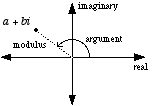
See also
cis, cosine, sine, complex number formulas, De Moivre’s theorem, polar-rectangular conversion formulas
Key Formula
z=r(cosθ+isinθ)=rcisθ
Where:
- z = The complex number
- r = The modulus (absolute value), equal to √(a² + b²), where a + bi is the rectangular form
- θ = The argument (angle measured counterclockwise from the positive real axis), found using θ = tan⁻¹(b/a) with quadrant adjustment
- i = The imaginary unit, where i² = −1
Worked Example
Problem: Convert the complex number z = 1 + i√3 to polar form.
Step 1: Identify a and b from the rectangular form a + bi.
a=1,b=3
Step 2: Calculate the modulus r using the formula r = √(a² + b²).
r=12+(3)2=1+3=4=2
Step 3: Find the argument θ. Since a > 0 and b > 0, the number is in Quadrant I, so use θ = tan⁻¹(b/a) directly.
θ=tan−1(13)=tan−1(3)=3π
Step 4: Write the polar form by substituting r and θ into the formula.
z=2(cos3π+isin3π)
Answer: z = 2(cos π/3 + i sin π/3), or equivalently 2 cis(π/3).
Another Example
This example involves a complex number in Quadrant III, requiring careful quadrant adjustment when computing the argument — a step where many students make errors.
Problem: Convert z = −3 − 3i to polar form.
Step 1: Identify a and b from the rectangular form.
a=−3,b=−3
Step 2: Calculate the modulus.
r=(−3)2+(−3)2=9+9=18=32
Step 3: Find the reference angle using tan⁻¹(|b/a|).
reference angle=tan−1(33)=tan−1(1)=4π
Step 4: Since both a and b are negative, the complex number lies in Quadrant III. Add π to the reference angle to get the correct argument.
θ=π+4π=45π
Step 5: Write the polar form.
z=32(cos45π+isin45π)
Answer: z = 3√2 (cos 5π/4 + i sin 5π/4), or 3√2 cis(5π/4).
Frequently Asked Questions
How do you convert a complex number from rectangular form to polar form?
Find the modulus r = √(a² + b²) and the argument θ = tan⁻¹(b/a), adjusting θ based on which quadrant the point (a, b) falls in. Then write the number as r(cos θ + i sin θ). The quadrant check is essential because tan⁻¹ alone only returns values between −π/2 and π/2.
Why is polar form useful for multiplying and dividing complex numbers?
When you multiply two complex numbers in polar form, you simply multiply their moduli and add their arguments: r₁ cis θ₁ · r₂ cis θ₂ = r₁r₂ cis(θ₁ + θ₂). For division, you divide the moduli and subtract the arguments. This is far simpler than expanding products using FOIL in rectangular form.
What is the difference between polar form and exponential form of a complex number?
Polar form uses trigonometric functions: r(cos θ + i sin θ). Exponential form uses Euler's formula to write the same number as re^(iθ). They represent the same thing — exponential form is just a more compact notation that follows directly from Euler's identity e^(iθ) = cos θ + i sin θ.
Polar Form vs. Rectangular Form
| Polar Form | Rectangular Form | |
|---|---|---|
| Notation | r(cos θ + i sin θ) or r cis θ | a + bi |
| Components | Modulus r and argument θ | Real part a and imaginary part b |
| Best for | Multiplication, division, powers, and roots | Addition and subtraction |
| Geometric meaning | Distance from origin and angle from positive real axis | Horizontal and vertical displacement on the complex plane |
| Conversion | a = r cos θ, b = r sin θ | r = √(a² + b²), θ = tan⁻¹(b/a) |
Why It Matters
Polar form appears throughout precalculus and introductory college math whenever you need to multiply, divide, or raise complex numbers to powers. De Moivre's Theorem, which requires polar form, lets you compute z^n or find nth roots of complex numbers efficiently. Electrical engineering and physics also rely heavily on polar representation of complex numbers to describe waves, impedance, and phasors.
Common Mistakes
Mistake: Using θ = tan⁻¹(b/a) without adjusting for the correct quadrant.
Correction: The arctangent function only returns angles in (−π/2, π/2). If the complex number is in Quadrant II or III (a < 0), you must add π to the arctangent result. If it is in Quadrant IV, you can add 2π to get a positive angle. Always plot the point to verify which quadrant it belongs to.
Mistake: Forgetting that the modulus r must always be non-negative.
Correction: The modulus is defined as r = √(a² + b²), which is always ≥ 0. If you get a negative value, you have made an arithmetic error. A negative sign belongs in the angle, not the modulus.
Related Terms
- Complex Numbers — The numbers being expressed in polar form
- Complex Plane — The coordinate plane where polar form is visualized
- Absolute Value of a Complex Number — The modulus r in the polar form
- Argument of a Complex Number — The angle θ in the polar form
- Cis — Shorthand notation for cos θ + i sin θ
- De Moivre's Theorem — Uses polar form to compute powers and roots
- Polar Coordinates — The coordinate system polar form is based on
- Polar-Rectangular Conversion Formulas — Formulas for switching between the two forms