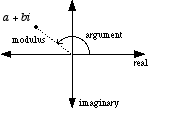
θ = The argument (angle from the positive real axis), adjusted to the correct quadrant
Worked Example
Problem: Find the argument of the complex number z = -1 + √3 i.
Step 1: Identify the real part a and the imaginary part b.
a=−1,b=3
Step 2: Compute the reference angle using arctan(|b/a|).
arctan(13)=3π
Step 3: Determine the quadrant. Since a < 0 and b > 0, the point lies in Quadrant II. In Quadrant II, the argument equals π minus the reference angle.
θ=π−3π=32π
Step 4: Verify by writing z in polar form. The modulus is r = √(1 + 3) = 2.
z=2(cos32π+isin32π)
Answer: The argument of z = -1 + √3 i is 2π/3 radians (120°).
Another Example
Problem: Find the argument of the complex number z = -3 - 3i.
Step 1: Identify the real and imaginary parts.
a=−3,b=−3
Step 2: Compute the reference angle.
arctan(33)=arctan(1)=4π
Step 3: Both parts are negative, so z lies in Quadrant III. The argument is π plus the reference angle.
θ=π+4π=45π
Step 4: As a principal argument (between −π and π), this is equivalently −3π/4.
Arg(z)=−43π
Answer: The argument of z = -3 − 3i is 5π/4 radians (or equivalently −3π/4 as the principal argument).
Frequently Asked Questions
What is the difference between 'argument' and 'principal argument' of a complex number?
The argument of a complex number is not unique — you can add any multiple of 2π and get another valid argument. The principal argument, often written Arg(z) with a capital A, is the unique value of the argument restricted to the interval (−π, π]. For example, both 5π/4 and −3π/4 are valid arguments of the same complex number, but only −3π/4 is the principal argument.
How do you find the argument when the complex number is on an axis?
If z lies on the positive real axis, the argument is 0. On the negative real axis, it is π. On the positive imaginary axis, the argument is π/2, and on the negative imaginary axis it is −π/2 (or equivalently 3π/2). The arctan formula doesn't directly apply in these cases because division by zero occurs when a = 0, so you determine the angle from the position on the axes.
Argument of a complex number vs. Modulus (absolute value) of a complex number
The argument tells you the direction of a complex number on the complex plane — how far to rotate from the positive real axis. The modulus tells you the distance from the origin. Together, they completely describe the complex number in polar form: z = r(cos θ + i sin θ), where r is the modulus and θ is the argument.
Why It Matters
The argument is essential for multiplying and dividing complex numbers in polar form, because you simply add or subtract arguments. It also plays a central role in De Moivre's theorem for computing powers and roots of complex numbers. Beyond pure algebra, arguments appear in signal processing, electrical engineering, and any field where phase angles matter.
Common Mistakes
Mistake: Using arctan(b/a) without adjusting for the correct quadrant.
Correction: The basic arctan function returns values only between −π/2 and π/2 (Quadrants I and IV). When the complex number lies in Quadrant II or III (a < 0), you must add or subtract π to get the correct angle. Alternatively, use the two-argument function atan2(b, a), which handles all four quadrants automatically.
Mistake: Forgetting that the argument is undefined for z = 0.
Correction: The complex number 0 + 0i sits at the origin and has no direction. Its argument is undefined, just as you cannot define an angle for a zero-length vector.