
Period of Periodic Motion
Period of Periodic Motion
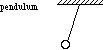
The time needed to complete a cycle. For example, a pendulum exhibits periodic motion. Its period is the time it takes for the pendulum to swing from one side to the other and then back again.
Note: Period is the reciprocal of frequency.
See also
Simple harmonic motion, period of a periodic function
Key Formula
T=f1
Where:
- T = Period — the time for one complete cycle, measured in seconds (s)
- f = Frequency — the number of complete cycles per second, measured in hertz (Hz)
Worked Example
Problem: A spring oscillates back and forth, completing 4 full cycles in 10 seconds. Find its period and frequency.
Step 1: Find the period by dividing the total time by the number of cycles.
T=number of cyclestotal time=410 s=2.5 s
Step 2: Verify by calculating the frequency using the reciprocal relationship.
f=T1=2.51=0.4 Hz
Step 3: Check: 0.4 cycles per second × 10 seconds = 4 cycles. This matches the original information.
f×t=0.4×10=4 cycles✓
Answer: The period is 2.5 seconds, and the frequency is 0.4 Hz.
Another Example
This example starts from frequency rather than counting cycles, and requires an extra step to find total elapsed time for multiple periods.
Problem: A pendulum has a frequency of 2 Hz. How long does it take to complete 15 full swings?
Step 1: Find the period from the given frequency.
T=f1=21=0.5 s
Step 2: Each full swing takes 0.5 seconds. Multiply the period by the number of swings to find the total time.
t=15×T=15×0.5=7.5 s
Answer: It takes 7.5 seconds for the pendulum to complete 15 full swings.
Frequently Asked Questions
What is the difference between period and frequency?
Period is the time for one complete cycle (measured in seconds), while frequency is the number of cycles per second (measured in hertz). They are reciprocals of each other: if you know one, flip it to get the other. A short period means a high frequency, and a long period means a low frequency.
What units is period measured in?
Period is always measured in units of time. The standard SI unit is seconds (s). For very fast oscillations you might see milliseconds (ms) or microseconds (μs), and for very slow motions you might see minutes or hours, but the fundamental unit remains time.
How do you find the period of a pendulum?
For a simple pendulum, the period is given by T=2πgL, where L is the length of the pendulum and g is the acceleration due to gravity (approximately 9.8 m/s²). Notice that the mass of the pendulum bob does not affect the period — only the length and gravity matter.
Period vs. Frequency
| Period | Frequency | |
|---|---|---|
| Definition | Time for one complete cycle | Number of cycles per unit time |
| Symbol | T | f |
| SI Unit | Seconds (s) | Hertz (Hz = 1/s) |
| Formula | T = 1/f | f = 1/T |
| Large value means | Slow oscillation | Fast oscillation |
| When to use | When you need the duration of one cycle | When you need how often cycles repeat |
Why It Matters
Period appears throughout physics and mathematics whenever you study repeating phenomena — from pendulums and springs in mechanics, to sound waves and light waves, to alternating current in electrical circuits. In math, the period of trigonometric functions like sine and cosine directly mirrors the period of physical oscillations, connecting algebra to real-world motion. Understanding period is essential for solving problems in simple harmonic motion, wave mechanics, and signal analysis.
Common Mistakes
Mistake: Confusing half a cycle with a full cycle. Students sometimes measure only the time for a pendulum to swing from one side to the other and call that the period.
Correction: A full period requires the object to return to its starting position and direction. For a pendulum, one period is a complete round trip: left → right → left (or right → left → right).
Mistake: Mixing up period and frequency formulas, such as writing T = f instead of T = 1/f.
Correction: Remember that period and frequency are reciprocals, not equal. If the frequency is 5 Hz, the period is 1/5 = 0.2 seconds, not 5 seconds. A quick sanity check: higher frequency should give a shorter period.
Related Terms
- Periodic Motion — The type of motion that has a period
- Frequency of Periodic Motion — The reciprocal of period
- Simple Harmonic Motion — A specific type of periodic motion (springs, pendulums)
- Period of a Periodic Function — The mathematical analog of physical period
- Amplitude — Maximum displacement in periodic motion
- Hertz — The SI unit of frequency (cycles per second)
- Wavelength — Spatial distance of one cycle in wave motion