
Limit
Limit
The value that a function or expression approaches as the domain variable(s) approach a specific value. Limits are written in the form  .
For example, the limit of
.
For example, the limit of  as x approaches
3 is
as x approaches
3 is  . This is written
  .
.
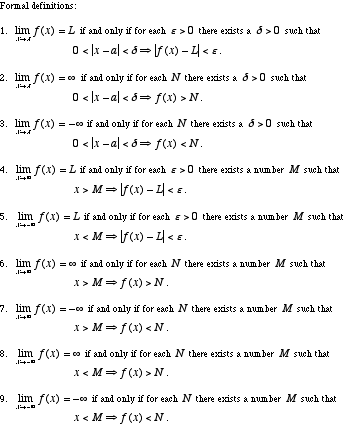
See also
Key Formula
x→climf(x)=L
Where:
- lim = The limit operator, read as 'the limit of'
- x→c = x approaches the value c (gets arbitrarily close but does not need to equal c)
- f(x) = The function being evaluated
- L = The value that f(x) approaches as x gets close to c
Worked Example
Problem: Find the limit: limx→2x−2x2−4
Step 1: Try direct substitution by plugging in x = 2.
2−222−4=00
Step 2: Direct substitution gives 0/0, which is an indeterminate form. This means you need to simplify the expression first.
Step 3: Factor the numerator. Recognize that x2−4 is a difference of squares.
x−2x2−4=x−2(x+2)(x−2)
Step 4: Cancel the common factor (x−2). This is valid because the limit considers values near x=2, not at x=2 itself.
x−2(x+2)(x−2)=x+2
Step 5: Now substitute x = 2 into the simplified expression.
x→2lim(x+2)=2+2=4
Answer: limx→2x−2x2−4=4
Another Example
This example shows the simplest case: when direct substitution works immediately because the function is continuous at the point. The first example required algebraic simplification to resolve an indeterminate form.
Problem: Find the limit: limx→5(3x+1)
Step 1: Try direct substitution by plugging in x = 5.
3(5)+1=15+1=16
Step 2: Since the function f(x)=3x+1 is a polynomial, it is continuous everywhere. Direct substitution works immediately with no further simplification needed.
x→5lim(3x+1)=16
Answer: limx→5(3x+1)=16
Frequently Asked Questions
What is the difference between a limit and the actual value of a function?
A limit describes what value a function approaches as the input gets close to a number, while the actual value is what you get by plugging that number in directly. These can differ. For example, a function might be undefined at x=2 (so it has no actual value there) yet still have a limit of 4 as x→2. When both exist and are equal, the function is said to be continuous at that point.
When does a limit not exist?
A limit does not exist (DNE) in three common situations: (1) the function approaches different values from the left and right sides (e.g., a jump in a piecewise function), (2) the function increases or decreases without bound (goes to ∞ or −∞), or (3) the function oscillates endlessly near the point, like sin(1/x) as x→0. For a limit to exist, the left-hand and right-hand limits must both exist and be equal.
What does 0/0 mean when finding a limit?
Getting 0/0 after direct substitution does not mean the limit is zero or undefined. It is called an indeterminate form, which signals that more work is needed. You should try factoring, rationalizing, or applying L'Hôpital's Rule to simplify the expression before substituting again.
Limit of a function vs. Value of a function
| Limit of a function | Value of a function | |
|---|---|---|
| Definition | The value f(x) approaches as x gets close to c | The output f(c) obtained by substituting x = c |
| Notation | limx→cf(x) | f(c) |
| Requires function to be defined at c? | No — the function can be undefined at c | Yes — f(c) must exist |
| When they agree | When the function is continuous at c, the limit equals the function value | When the function is continuous at c, the function value equals the limit |
Why It Matters
Limits are the foundation of calculus. The derivative is defined as a limit of a difference quotient, and the definite integral is defined as a limit of Riemann sums. You will encounter limits directly in every calculus course, and understanding them is essential for topics like continuity, asymptotic behavior, and series convergence.
Common Mistakes
Mistake: Assuming that if f(c) is undefined, the limit does not exist.
Correction: A limit depends on the behavior of the function near c, not at c. A function can be undefined at a point yet still have a well-defined limit there. For example, x−2x2−4 is undefined at x=2, but limx→2x−2x2−4=4.
Mistake: Treating the indeterminate form 00 as an answer (either 0 or undefined).
Correction: 00 is not a number — it is a signal that the expression needs further simplification. Factor, cancel, rationalize, or apply L'Hôpital's Rule before substituting again.
Related Terms
- Function — Limits describe the behavior of functions
- Expression — Limits can be taken of algebraic expressions
- Domain — The variable approaches a value in the domain's neighborhood
- Variable — The input variable that approaches a specific value
- Limit from the Left — One-sided limit as x approaches c from below
- Limit from the Right — One-sided limit as x approaches c from above
- Continuous — A function is continuous when the limit equals the function value
- Derivative — Defined as a limit of a difference quotient