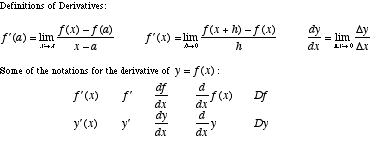
A function which gives the slope
of a curve; that is, the slope of
the line
tangent to a function.
The derivative of a function f at
a pointx is commonly written f
'(x).
For example, if f(x) = x3 then f '(x)
= 3x2.
The slope of the tangent line when x = 5 is f '(x)
= 3·52 = 75.
f(x) = The original function whose derivative you want to find
f′(x) = The derivative of f, giving the slope of the tangent line at any point x
h = A small increment that approaches zero
f(x+h) = The value of the function at a point slightly ahead of x
Worked Example
Problem: Find the derivative of f(x) = x² using the limit definition, then evaluate it at x = 3.
Step 1: Write the difference quotient by substituting f(x) = x² into the limit definition.
f′(x)=h→0limh(x+h)2−x2
Step 2: Expand (x + h)² and simplify the numerator.
=h→0limhx2+2xh+h2−x2=h→0limh2xh+h2
Step 3: Factor h from the numerator and cancel with the denominator.
=h→0limhh(2x+h)=h→0lim(2x+h)
Step 4: Let h approach 0 to find the derivative function.
f′(x)=2x
Step 5: Evaluate the derivative at x = 3 to find the slope of the tangent line at that point.
f′(3)=2(3)=6
Answer: The derivative of f(x) = x² is f'(x) = 2x. At x = 3, the slope of the tangent line is 6.
Another Example
This example uses the power rule shortcut instead of the limit definition, showing how derivative rules speed up the process for polynomial functions.
Problem: Find the derivative of f(x) = 5x³ − 4x + 7 using the power rule, then find the slope of the tangent line at x = 2.
Step 1: Apply the power rule to each term. The power rule states that the derivative of xⁿ is nxⁿ⁻¹. Constants have a derivative of 0.
dxd[xn]=nxn−1
Step 2: Differentiate the first term: 5x³ becomes 5 · 3x².
dxd[5x3]=15x2
Step 3: Differentiate −4x (which is −4x¹) and the constant 7.
dxd[−4x]=−4,dxd[7]=0
Step 4: Combine the results and evaluate at x = 2.
f′(x)=15x2−4⇒f′(2)=15(4)−4=56
Answer: f'(x) = 15x² − 4, and the slope of the tangent line at x = 2 is 56.
Frequently Asked Questions
What is the difference between a derivative and a slope?
Slope usually refers to the constant rate of change of a straight line (rise over run). The derivative generalizes this idea to curves: it gives the slope of the tangent line at each individual point. For a linear function like f(x) = 3x + 2, the derivative is simply the constant slope, 3. For curves, the derivative changes depending on where you are on the graph.
When do you use the limit definition versus derivative rules?
The limit definition is the foundational formula that proves what the derivative is from first principles. In practice, you use derivative rules (power rule, product rule, chain rule, etc.) because they are much faster. Most courses require you to use the limit definition a few times to understand the concept, then switch to rules for efficiency.
What does it mean when the derivative equals zero?
When f'(x) = 0 at a point, the tangent line at that point is horizontal. This means the function has momentarily stopped increasing or decreasing. These points are called critical points and often correspond to local maxima, local minima, or inflection points of the function. Finding where the derivative equals zero is a key step in optimization problems.
Derivative vs. Integral
Derivative
Integral
Definition
Rate of change (slope) of a function at a point
Accumulation of area under a curve
Notation
f'(x) or dy/dx
∫ f(x) dx or F(x)
Geometric meaning
Slope of the tangent line
Area between the curve and the x-axis
Operation
Differentiation — reduces polynomial degree by 1
Integration — increases polynomial degree by 1
Relationship
Inverse of integration
Inverse of differentiation (by the Fundamental Theorem of Calculus)
Why It Matters
The derivative is the central concept of differential calculus and appears throughout science, engineering, and economics. In physics, velocity is the derivative of position with respect to time, and acceleration is the derivative of velocity. Students encounter derivatives heavily in AP Calculus, college math courses, and any field that studies how quantities change.
Common Mistakes
Mistake: Forgetting to subtract 1 from the exponent when using the power rule.
Correction: The power rule requires both multiplying by the exponent AND reducing it by 1. For x⁴, the derivative is 4x³, not 4x⁴.
Mistake: Treating the derivative of a product as the product of the derivatives: writing (fg)' = f' · g'.
Correction: The correct product rule is (fg)' = f'g + fg'. You must apply the product rule whenever two non-constant functions are multiplied together.