
Tangent Line
Tangent Line
A line that touches a curve at a point without crossing over. Formally, it is a line which intersects a differentiable curve at a point where the slope of the curve equals the slope of the line.
Note: A line tangent to a circle is perpendicular to the radius to the point of tangency.
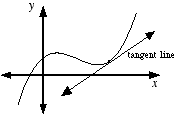
Key Formula
y−f(a)=f′(a)(x−a)
Where:
- a = The x-coordinate of the point of tangency
- f(a) = The y-coordinate of the point of tangency (the function value at x = a)
- f′(a) = The derivative of f evaluated at x = a, which gives the slope of the tangent line
- x,y = The coordinates of any point on the tangent line
Worked Example
Problem: Find the equation of the tangent line to the curve f(x) = x² at the point where x = 3.
Step 1: Find the y-coordinate of the point of tangency by evaluating f(3).
f(3)=32=9
Step 2: Find the derivative of f(x), which gives the slope formula for the curve.
f′(x)=2x
Step 3: Evaluate the derivative at x = 3 to get the slope of the tangent line.
f′(3)=2(3)=6
Step 4: Substitute into the point-slope form of the tangent line equation using the point (3, 9) and slope 6.
y−9=6(x−3)
Step 5: Simplify to slope-intercept form.
y=6x−9
Answer: The equation of the tangent line to f(x) = x² at x = 3 is y = 6x − 9.
Another Example
This example uses the geometric property of circles (tangent ⊥ radius) instead of calculus. It shows that tangent lines can be found without derivatives when the curve has special geometric properties.
Problem: Find the equation of the tangent line to the circle x² + y² = 25 at the point (3, 4).
Step 1: Verify that the point (3, 4) lies on the circle by substituting into the equation.
32+42=9+16=25✓
Step 2: The radius from the center (0, 0) to (3, 4) has slope:
mradius=3−04−0=34
Step 3: A tangent to a circle is perpendicular to the radius at the point of tangency. Perpendicular slopes are negative reciprocals.
mtangent=−43
Step 4: Use point-slope form with the point (3, 4) and the tangent slope.
y−4=−43(x−3)
Step 5: Simplify to slope-intercept form.
y=−43x+425
Answer: The tangent line to the circle x² + y² = 25 at (3, 4) is y = −(3/4)x + 25/4.
Frequently Asked Questions
What is the difference between a tangent line and a secant line?
A secant line intersects a curve at two distinct points, while a tangent line touches the curve at one point and matches the curve's slope there. The tangent line can be thought of as the limit of secant lines as the two intersection points get closer and closer together. This limiting process is the foundation of the derivative in calculus.
Can a tangent line cross the curve?
Yes, a tangent line can cross the curve at the point of tangency if the curve has an inflection point there. For example, the tangent line to y = x³ at the origin is y = 0 (the x-axis), and the curve crosses from below to above this line at that point. The defining property is that the line matches the slope of the curve, not that it stays on one side.
How do you find the tangent line without using calculus?
For circles, you can use the fact that the tangent is perpendicular to the radius at the point of tangency. For parabolas and other conics, there are algebraic methods involving setting a line equal to the curve and requiring the resulting equation to have a repeated root (discriminant = 0). However, the derivative method from calculus works for any differentiable curve and is the most general approach.
Tangent Line vs. Secant Line
| Tangent Line | Secant Line | |
|---|---|---|
| Definition | A line that touches a curve at one point and matches the curve's slope there | A line that intersects a curve at two distinct points |
| Slope formula | m = f'(a) (the derivative at the point) | m = [f(b) − f(a)] / (b − a) (average rate of change) |
| Number of intersection points | Touches at one point (locally) | Crosses at two points |
| Relation to each other | Limit of secant lines as the two points merge | Approximation to the tangent line using two nearby points |
| When to use | Finding instantaneous rate of change | Finding average rate of change over an interval |
Why It Matters
Tangent lines appear as soon as you study derivatives in calculus — the derivative at a point is defined as the slope of the tangent line. In physics, the tangent line to a position-time graph gives the instantaneous velocity. You will also encounter tangent lines in optimization problems, linear approximation, and Newton's method for finding roots of equations.
Common Mistakes
Mistake: Using the function value f(a) as the slope instead of the derivative f'(a).
Correction: The slope of the tangent line is f'(a), not f(a). First differentiate the function, then substitute x = a into the derivative. For example, if f(x) = x² and a = 3, the slope is f'(3) = 6, not f(3) = 9.
Mistake: Forgetting to write the full equation of the tangent line and giving only the slope.
Correction: The slope alone does not define a unique line. You must use point-slope form y − f(a) = f'(a)(x − a) to specify which line with that slope passes through the correct point on the curve.
Related Terms
- Slope of a Curve — The tangent line's slope equals the curve's slope
- Differentiable — A curve must be differentiable to have a tangent line
- Slope of a Line — The tangent line has a specific slope value
- Line — A tangent line is a specific type of line
- Curve — The shape the tangent line touches
- Perpendicular — Tangent to a circle is perpendicular to the radius
- Circle — Common shape where tangent lines are studied in geometry
- Radius of a Circle or Sphere — Perpendicular to the tangent line at the point of tangency