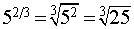
The use of rational
numbers as exponents.
A rational exponent represents both an integer exponent
and an nth
root. The root is
found in the
denominator (like a tree,
the root is at the bottom), and the integer exponent is found
in the numerator.
x = The base — any real number (must be non-negative when n is even)
m = The numerator of the exponent — the integer power applied to the base
n = The denominator of the exponent — the index of the root (must be a positive integer)
Worked Example
Problem:Simplify 82/3.
Step 1: Identify the numerator and denominator of the exponent. The numerator is 2 (the power) and the denominator is 3 (the root).
832=(38)2
Step 2:Find the cube root of 8. Since 2×2×2=8, the cube root of 8 is 2.
38=2
Step 3: Raise the result to the power of 2.
22=4
Answer:82/3=4
Another Example
This example combines rational exponents with a negative exponent, showing students how to handle the reciprocal step before applying the fractional exponent rule.
Problem:Simplify 27−2/3.
Step 1: Handle the negative exponent first. A negative exponent means you take the reciprocal.
27−32=27321
Step 2:Now evaluate 272/3. The denominator 3 tells you to take the cube root; the numerator 2 tells you to square the result.
2732=(327)2
Step 3:Find the cube root of 27. Since 33=27, the cube root is 3.
327=3
Step 4: Square the result, then take the reciprocal.
32=9⇒91
Answer:27−2/3=91
Frequently Asked Questions
How do you convert between rational exponents and radicals?
Use the rule xm/n=nxm. The denominator of the fraction becomes the index of the radical, and the numerator stays as the power inside (or outside) the radical. For example, x3/4=4x3. You can also reverse this: 5x2=x2/5.
Does it matter whether you take the root first or the power first?
Mathematically, no — nxm and (nx)m give the same result. However, taking the root first usually produces smaller numbers and makes the arithmetic much easier. For instance, with 642/3, finding 364=4 first and then squaring to get 16 is simpler than computing 642=4096 and then finding its cube root.
What happens when the denominator of a rational exponent is even and the base is negative?
When the denominator is even, you are taking an even root (like a square root or fourth root). Even roots of negative numbers are not defined in the real number system. For example, (−4)1/2 is not a real number because no real number squared gives −4. This restriction only applies when the denominator is even.
Rational Exponents vs. Radical Notation
Rational Exponents
Radical Notation
Notation
xm/n
nxm
Indicates
A fractional power written as an exponent
A root written with a radical symbol
Ease of simplification
Easier to apply exponent rules (product rule, power rule, etc.)
More intuitive for simple roots like square roots and cube roots
When to use
Preferred in algebra when combining or simplifying expressions with exponent rules
Preferred when evaluating a specific root or when the problem is given in radical form
Why It Matters
Rational exponents appear throughout Algebra 2, precalculus, and calculus whenever you need to differentiate or simplify expressions involving roots. They let you apply all the familiar exponent rules — product rule, quotient rule, power rule — to expressions that would be awkward to handle with radical signs. Understanding rational exponents is also essential for solving equations like x3/2=27 and for working with exponential growth and decay models in science courses.
Common Mistakes
Mistake:Confusing which part of the fraction is the root and which is the power — for example, interpreting x2/3 as x3 instead of 3x2.
Correction:Remember: the denominator is the root ("the root is at the bottom") and the numerator is the power. So x2/3=3x2, not x3.
Mistake:Treating x1/2+x1/2 as x1 by adding the exponents.
Correction:You only add exponents when multiplying terms with the same base: x1/2⋅x1/2=x1. When adding like terms, x1/2+x1/2=2x1/2, just as y+y=2y.
Related Terms
Exponent — General concept that rational exponents extend
nth Root — The denominator of a rational exponent represents this
Radical Rules — Rules for radicals that parallel rational exponent rules