Integral
Rules
For the following, a, b, c, and C are constants;
for definite integrals, these represent real
number constants. The rules only apply when the integrals exist.
Indefinite integrals (These
rules all apply to definite
integrals as well)
1. 
2. ![Integral sum rule: ∫[f(u) + g(u)] du = ∫f(u) du + ∫g(u) du](i_assets/indefinite%20integral%20rule%202.gif)
3. ![Integral rule: the integral of [f(u) − g(u)] du equals the integral of f(u) du minus the integral of g(u) du](i_assets/indefinite%20integral%20rule%203.gif)
4. ![Integral rule: ∫[af(u) + bg(u)] du = a∫f(u) du + b∫g(u) du (linearity of integration)](i_assets/indefinite%20integral%20rule%204.gif)
5. Integration by parts: 
Definite integrals
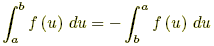
1. 
2. 
3. If f(u) ≤ g(u)
for all a ≤ u ≤ b,
then 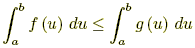
4. If f(u) ≤ M for
all a ≤ u ≤ b,
then 
5. If m ≤ f(u)
for all a ≤ u ≤ b,
then 
6. If a ≤ b, then 
See
also
Integral table, integration
methods , derivative rules
Worked Example
Problem: Evaluate the indefinite integral: ∫ (3x⁴ + 5x² − 2) dx
Step 1: Apply the sum/difference rule to split the integral into three separate integrals.
∫(3x4+5x2−2)dx=∫3x4dx+∫5x2dx−∫2dx Step 2: Apply the constant multiple rule to pull each constant factor out of its integral.
=3∫x4dx+5∫x2dx−2∫dx Step 3: Apply the power rule to each term. For x⁴, raise the exponent by 1 to get 5 and divide by 5. For x², raise to 3 and divide by 3. For the constant, use ∫ dx = x.
=3⋅5x5+5⋅3x3−2x+C Step 4: Simplify the coefficients.
=53x5+35x3−2x+C Answer: 53x5+35x3−2x+C Another Example
This example demonstrates the integration by parts rule on a definite integral, whereas the first example used only the power rule, sum rule, and constant multiple rule on an indefinite integral.
Problem: Evaluate the definite integral using integration by parts: ∫₀² x·eˣ dx
Step 1: Identify the parts for integration by parts. Let u = x (so du = dx) and let dv = eˣ dx (so v = eˣ).
u=x,dv=exdx⇒du=dx,v=ex Step 2: Apply the integration by parts formula: ∫ u dv = uv − ∫ v du.
∫02xexdx=[xex]02−∫02exdx Step 3: Evaluate the boundary term [xeˣ] from 0 to 2.
[xex]02=2e2−0⋅e0=2e2 Step 4: Evaluate the remaining integral ∫₀² eˣ dx.
∫02exdx=[ex]02=e2−e0=e2−1 Step 5: Combine the results.
2e2−(e2−1)=2e2−e2+1=e2+1≈8.389 Answer: e2+1≈8.389 Frequently Asked Questions
What is the difference between integral rules and derivative rules?
Integral rules reverse the process of derivative rules. While derivative rules tell you how to find the rate of change of a function, integral rules tell you how to find the original function (antiderivative) or the accumulated area under a curve. Many integral rules are derived by 'undoing' a corresponding derivative rule — for example, the power rule for integrals reverses the power rule for derivatives.
When do you use integration by parts versus the power rule?
Use the power rule when your integrand is a simple power of the variable, like xⁿ. Use integration by parts when you have a product of two different types of functions (such as a polynomial times an exponential, or x times sin x) that cannot be simplified by basic algebra or substitution. The mnemonic LIATE (Logarithmic, Inverse trig, Algebraic, Trigonometric, Exponential) helps you choose which factor to set as u.
Do all integral rules apply to both definite and indefinite integrals?
The core algebraic rules — constant multiple, sum/difference, power rule, and integration by parts — apply to both types. However, definite integrals have additional properties specific to their limits, such as reversing limits introduces a negative sign, and comparison/bounding inequalities only make sense when you have specific endpoints.
Integral Rules vs. Derivative Rules
| Integral Rules | Derivative Rules |
|---|
| Purpose | Find antiderivatives or accumulated quantities | Find instantaneous rates of change |
| Power Rule | ∫ xⁿ dx = xⁿ⁺¹/(n+1) + C, n ≠ −1 | d/dx [xⁿ] = nxⁿ⁻¹ |
| Constant Multiple | ∫ c·f(x) dx = c·∫ f(x) dx | d/dx [c·f(x)] = c·f′(x) |
| Product of Functions | No simple product rule; use integration by parts | Product rule: d/dx [f·g] = f′g + fg′ |
| Result includes | + C (constant of integration) for indefinite integrals | A specific function (no arbitrary constant) |
Why It Matters
Integral rules form the backbone of every calculus course from AP Calculus onward. You use them to compute areas, volumes, average values, work, and accumulated change in physics and engineering problems. Mastering these rules is essential because nearly every integration problem — whether on a test or in real-world modeling — requires combining several of them together.
Common Mistakes
Mistake: Forgetting the constant of integration C on indefinite integrals.
Correction: Every indefinite integral represents a family of functions differing by a constant. Always write + C unless you are evaluating a definite integral where the constants cancel.
Mistake: Applying the power rule when n = −1 (i.e., integrating 1/x).
Correction: The power rule requires n ≠ −1. When n = −1, the integral of x⁻¹ is ln|x| + C, not x⁰/0. This is a special case that students frequently overlook.
