
Inequality Rules
Inequality Rules
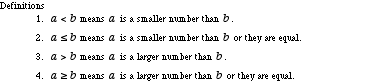
Algebra rules for manipulating inequalities are listed below.
Transitive Property of Inequalities
If a < b and b < c , then a < c.
If a ≤ b and b ≤ c , then a ≤ c.
If a > b and b > c , then a > c.
If a ≥ b and b ≥ c , then a ≥ c.

See also
Equation rules, trichotomy, equivalence properties of equality
Key Formula
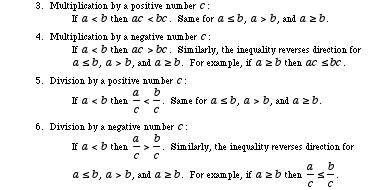
If a<b and c>0, then ac<bc
If a<b and c<0, then ac>bc
Where:
- a,b = Real numbers being compared in the inequality
- c = A nonzero real number you multiply (or divide) both sides by
- <,> = Strict inequality symbols; the same rules apply to ≤ and ≥
Worked Example
Problem: Solve the inequality −3x + 6 < 15 for x.
Step 1: Subtract 6 from both sides. Subtracting the same number preserves the inequality direction.
−3x+6−6<15−6⟹−3x<9
Step 2: Divide both sides by −3. Because you are dividing by a negative number, you must flip the inequality sign.
−3−3x>−39⟹x>−3
Step 3: State the solution. The inequality sign flipped from < to > in the previous step.
x>−3
Answer: x > −3. Any value greater than −3 satisfies the original inequality.
Another Example
This example uses the transitive property and a non-strict inequality (≤), whereas the first example focused on flipping the sign when dividing by a negative.
Problem: Solve the compound inequality 2x − 1 ≤ 7 and 7 < 3x + 1, then combine the results using the transitive property.
Step 1: Solve the first inequality. Add 1 to both sides, then divide by 2 (positive, so the sign stays).
2x−1≤7⟹2x≤8⟹x≤4
Step 2: Solve the second inequality. Subtract 1 from both sides, then divide by 3 (positive, so the sign stays).
7<3x+1⟹6<3x⟹2<x
Step 3: Combine using the transitive property. Since 2 < x and x ≤ 4, you can chain these into a single statement.
2<x≤4
Answer: 2 < x ≤ 4. The solution set is all real numbers strictly greater than 2 and at most 4.
Frequently Asked Questions
Why do you flip the inequality sign when multiplying or dividing by a negative number?
Multiplying by a negative number reverses the order of numbers on the number line. For example, 2 < 5, but multiplying both by −1 gives −2 and −5, and −2 > −5. If you did not flip the sign, the resulting statement would be false. This rule applies every time you multiply or divide both sides by any negative value.
Do inequality rules work the same way for ≤ and ≥ as for < and >?
Yes. Every rule — addition, subtraction, multiplication, division, and the transitive property — applies identically to non-strict inequalities (≤, ≥) as to strict ones (<, >). The only additional note is that equality is preserved: if a ≤ b and you add c, then a + c ≤ b + c, including the possibility that both sides are equal.
What is the transitive property of inequalities?
The transitive property states that if a < b and b < c, then a < c. It lets you chain inequalities together. The same logic holds for >, ≤, and ≥. This property is especially useful when solving compound inequalities or comparing three or more expressions.
Inequality Rules vs. Properties of Equality
| Inequality Rules | Properties of Equality | |
|---|---|---|
| Core idea | Rules for preserving or reversing the direction of <, >, ≤, ≥ | Rules for keeping both sides of an equation equal (=) |
| Multiplying by a negative | You must flip the inequality sign | No sign to flip — equality is always preserved |
| Addition/Subtraction | Add or subtract the same value on both sides; direction unchanged | Add or subtract the same value on both sides; equality unchanged |
| Solution type | Typically a range of values (e.g., x > 3) | Typically a specific value (e.g., x = 3) |
| Transitive property | If a < b and b < c, then a < c | If a = b and b = c, then a = c |
Why It Matters
Inequality rules appear throughout algebra whenever you solve for a variable inside an inequality, which is common in word problems involving constraints like budgets, speed limits, or minimum scores. They are essential in graphing linear inequalities, solving systems of inequalities, and working with absolute value inequalities. In later courses such as calculus and optimization, these same rules underpin how you determine intervals where functions are positive, negative, increasing, or decreasing.
Common Mistakes
Mistake: Forgetting to flip the inequality sign when multiplying or dividing both sides by a negative number.
Correction: Always check the sign of the number you multiply or divide by. If it is negative, reverse the direction of the inequality. For example, dividing both sides of −2x > 10 by −2 gives x < −5, not x > −5.
Mistake: Flipping the inequality sign when subtracting a number from both sides.
Correction: Addition and subtraction never change the direction of an inequality, regardless of whether the number is positive or negative. Only multiplication or division by a negative triggers a flip. For instance, subtracting 5 from both sides of x + 5 > 12 correctly gives x > 7 — no flip needed.
Related Terms
- Inequality — The fundamental concept these rules manipulate
- Algebra — The broader subject containing inequality rules
- Transitive Property of Inequalities — Key rule for chaining inequalities together
- Properties of Equality — Analogous rules for equations instead of inequalities
- Trichotomy — States every pair of reals satisfies exactly one of <, =, >
- Equivalence Properties of Equality — Parallel equality properties: reflexive, symmetric, transitive
- Absolute Value Inequalities — Applies inequality rules to solve |expression| < or > a value