Independent Variable
A variable in an equation that
may have its value freely chosen without considering values of
any
other
variable.
For equations such as y = 3x – 2,
the independent variable is x. The variable y is not independent since it depends
on the number chosen for x.
Formally, an independent variable
is a variable which can be assigned any permissible value without
any restriction imposed by any other variable.
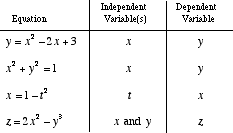
See
also
Dependent variable
Worked Example
Problem: A movie theater charges $8 per ticket. The total cost is given by the equation C = 8t, where t is the number of tickets and C is the total cost in dollars. Identify the independent variable, then find the total cost when you buy 5 tickets.
Step 1: Determine which variable you choose freely. You decide how many tickets to buy — that is t. No other variable restricts your choice of t.
Step 2: Determine which variable depends on the other. The total cost C is calculated from t, so C depends on the value you pick for t. Therefore C is the dependent variable.
Step 3: Substitute the chosen value of the independent variable, t = 5, into the equation.
C=8(5)=40 Answer: The independent variable is t (number of tickets). When t = 5, the total cost is $40.
Another Example
Problem: The equation y = x² − 4 defines a relationship between x and y. Identify the independent variable and compute y when x = 3.
Step 1: You can pick any real number for x without restriction. That makes x the independent variable.
Step 2: The value of y is then forced by your choice of x, making y the dependent variable.
Step 3: Substitute x = 3 into the equation.
y=(3)2−4=9−4=5 Answer: The independent variable is x. When x = 3, y = 5.
Frequently Asked Questions
How do you tell which variable is independent and which is dependent?
The independent variable is the one you choose or control — it does not rely on any other variable in the equation. The dependent variable is calculated from the independent variable. In y = 3x + 1, you pick x (independent) and then compute y (dependent). On a graph, the independent variable is almost always on the horizontal axis.
Is the independent variable always x?
No. The letter used is just a label. In the equation d=60t, the independent variable is t (time), and d (distance) is dependent. The independent variable is identified by its role — the input you freely choose — not by the letter assigned to it. Independent Variable vs. Dependent Variable
The independent variable is the input whose value you freely select. The dependent variable is the output whose value is determined by the independent variable. In y = 2x + 5, x is independent (you choose it) and y is dependent (it is computed from x). On a coordinate graph, the independent variable is plotted on the x-axis and the dependent variable on the y-axis.
Why It Matters
Identifying the independent variable is essential whenever you graph an equation, design a science experiment, or analyze data. It tells you which quantity to place on the horizontal axis and which quantity is being measured as a response. In real-world applications — from calculating costs to predicting population growth — clearly distinguishing the independent variable from the dependent variable keeps your reasoning organized and your results meaningful.
Common Mistakes
Mistake: Assuming the independent variable must always be called x.
Correction: The independent variable can use any letter or symbol. Identify it by its role (the freely chosen input), not by its name. For instance, in A = πr², the independent variable is r.
Mistake: Confusing which variable goes on which axis when graphing.
Correction: The independent variable belongs on the horizontal axis and the dependent variable on the vertical axis. Placing them on the wrong axes misrepresents the relationship.
