
Dependent Variable
Dependent Variable
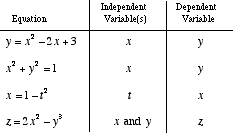
A variable that depends on one or more other variables. For equations such as y = 3x – 2, the dependent variable is y. The value of y depends on the value chosen for x. Usually the dependent variable is isolated on one side of an equation. Formally, a dependent variable is a variable in an expression, equation, or function that has its value determined by the choice of value(s) of other variable(s).
See also
Key Formula
y=f(x)
Where:
- y = The dependent variable — its value is the output
- f = The function or rule that relates x to y
- x = The independent variable — its value is freely chosen as input
Worked Example
Problem: For the equation y = 5x + 10, identify the dependent variable and find its value when x = 4.
Step 1: Identify the dependent variable. The variable y is isolated on one side and its value is determined by x, so y is the dependent variable.
y=5x+10
Step 2: Substitute the chosen value x = 4 into the equation.
y=5(4)+10
Step 3: Multiply first, then add.
y=20+10
Step 4: Compute the final value of y.
y=30
Answer: The dependent variable is y, and when x = 4, y = 30.
Another Example
This example shows that a dependent variable can depend on more than one independent variable, not just a single x.
Problem: A function has two independent variables: z = 2a + 3b. Find the dependent variable and compute its value when a = 5 and b = 4.
Step 1: Identify the dependent variable. The variable z is isolated on the left side, and its value depends on both a and b. So z is the dependent variable.
z=2a+3b
Step 2: Substitute a = 5 and b = 4 into the equation.
z=2(5)+3(4)
Step 3: Evaluate each term.
z=10+12
Step 4: Add to find z.
z=22
Answer: The dependent variable is z, and when a = 5 and b = 4, z = 22.
Frequently Asked Questions
What is the difference between a dependent variable and an independent variable?
The independent variable is the input — you choose its value freely. The dependent variable is the output — its value is calculated from the independent variable using the equation or function. In y = 3x + 1, you pick x (independent) and the equation gives you y (dependent).
How do you identify the dependent variable in an equation?
Look for the variable that is isolated on one side of the equation. That variable's value is determined by the other variables, making it the dependent variable. For example, in y = x² − 7, the variable y is alone on the left side and depends on x, so y is dependent.
Which axis is the dependent variable on a graph?
On a standard coordinate plane, the dependent variable is plotted on the vertical axis (the y-axis). The independent variable goes on the horizontal axis (the x-axis). Each point on the graph shows how the dependent variable responds to a particular value of the independent variable.
Dependent Variable vs. Independent Variable
| Dependent Variable | Independent Variable | |
|---|---|---|
| Definition | A variable whose value is determined by other variables | A variable whose value is freely chosen |
| Role in a function | Output of the function | Input of the function |
| Position in an equation | Usually isolated on one side (e.g., y = ...) | Appears on the other side of the equation |
| Axis on a graph | Vertical axis (y-axis) | Horizontal axis (x-axis) |
| Example in y = 2x + 5 | y | x |
| Real-world analogy | Total cost of items (depends on quantity) | Number of items you decide to buy |
Why It Matters
Understanding dependent variables is essential for graphing equations, interpreting scientific experiments, and working with functions throughout algebra and beyond. In science classes, identifying the dependent variable helps you determine what you are measuring versus what you are controlling. Whenever you write a function, build a table of values, or read a graph, you are working with the idea of a dependent variable.
Common Mistakes
Mistake: Confusing which variable is dependent and which is independent when the equation is not solved for one variable (e.g., 3x + 2y = 12).
Correction: Rearrange the equation so that one variable is isolated. For instance, solving for y gives y = (12 − 3x)/2, which shows y is the dependent variable. If no context is given, the variable you solve for is typically treated as dependent.
Mistake: Thinking the dependent variable must always be called y.
Correction: Any letter can be a dependent variable. In A = πr², the dependent variable is A (area), which depends on r (radius). The name of the variable does not matter — what matters is which variable's value is determined by the others.
Related Terms
- Independent Variable — The input variable that the dependent variable relies on
- Variable — General term for a symbol representing a quantity
- Function — A rule that assigns each input exactly one output
- Equation — A statement showing the relationship between variables
- Expression — A combination of variables and operations without an equals sign
- Domain — The set of allowed values for the independent variable
- Range — The set of possible values of the dependent variable