Arithmetic Series
A
series such as 3 + 7 + 11 +
15 + ··· +
99 or 10 + 20 + 30 + ··· + 1000 which
has a constant difference between terms.
The first term is a1, the common difference
is d,
and the number of terms is n. The sum of
an arithmetic series is found by multiplying the number of
terms times
the average of the first and last terms.
| Formula: |
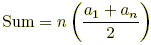 or or ![Formula: (n/2)[2a₁ + (n-1)d]](/a/a_assets/arithmetic sum formula2.gif) |
| |
|
| Example: |
3 + 7 + 11 + 15 + ··· + 99 has a1 = 3 and d = 4. To find n, use the explicit formula for an arithmetic sequence.
We solve 3 + (n – 1)·4 = 99 to get n = 25.

or ![Formula: Sum = (25/2)[2·3 + (25−1)·4] = 1275, showing arithmetic series sum calculation with n=25, a1=3, d=4.](/a/a_assets/arithmetic sum formula2ex.gif)
|
See
also
Geometric
series
Worked Example
Problem: Find the sum of the arithmetic series 3 + 7 + 11 + 15 + ··· + 99.
Step 1: Identify the first term and common difference.
a1=3,d=7−3=4 Step 2: Find the number of terms n by using the explicit formula for the nth term: an=a1+(n−1)d. Set an=99 and solve.3+(n−1)(4)=99⟹4(n−1)=96⟹n−1=24⟹n=25 Step 3: Apply the sum formula using the first and last terms.
S25=225(3+99)=225(102)=25×51 Step 4: Compute the final result.
S25=1275 Answer: The sum of the series 3 + 7 + 11 + 15 + ··· + 99 is 1,275.
Another Example
This example differs because the last term is not explicitly given. It demonstrates the second form of the formula, which uses d instead of the last term.
Problem: Find the sum of the first 50 terms of an arithmetic series whose first term is 6 and whose common difference is 3.
Step 1: Record what you know. Here n is given directly, so there is no need to solve for it.
a1=6,d=3,n=50 Step 2: Since the last term is not given, use the alternative form of the sum formula.
Sn=2n[2a1+(n−1)d] Step 3: Substitute the known values.
S50=250[2(6)+(50−1)(3)]=25[12+147]=25×159 Step 4: Compute the final result.
S50=3975 Answer: The sum of the first 50 terms is 3,975.
Frequently Asked Questions
What is the difference between an arithmetic sequence and an arithmetic series?
An arithmetic sequence is a list of numbers with a constant difference between consecutive terms, such as 2, 5, 8, 11, …. An arithmetic series is the sum of those terms: 2 + 5 + 8 + 11 + …. In short, a sequence lists the terms while a series adds them up.
How do you find the number of terms in an arithmetic series?
Use the explicit formula for the nth term: an=a1+(n−1)d. Plug in the last term for an, the first term for a1, and the common difference for d, then solve for n. For example, if the series runs from 5 to 95 with d=5, solving 5+(n−1)(5)=95 gives n=19. Why does the arithmetic series formula work?
The formula works because of a pairing trick famously attributed to Gauss. If you write the series forwards and backwards and add them together, every pair sums to a1+an. Since there are n such pairs spread across two copies of the series, the total of one copy is 2n(a1+an). Arithmetic Series vs. Geometric Series
| Arithmetic Series | Geometric Series |
|---|
| Pattern between terms | Constant difference d between consecutive terms | Constant ratio r between consecutive terms |
| Sum formula (finite) | Sn=2n(a1+an) | Sn=a1⋅1−r1−rn |
| Infinite sum | Does not converge (diverges to ±∞ unless all terms are 0) | Converges to 1−ra1 when ∣r∣<1 |
| Typical example | 2 + 5 + 8 + 11 + 14 | 3 + 6 + 12 + 24 + 48 |
Why It Matters
Arithmetic series appear throughout algebra and precalculus courses, and they form a foundation for understanding sigma notation and more advanced series in calculus. Practical applications include calculating total payments on a linearly increasing schedule, summing rows of a triangular arrangement, or finding the total distance traveled when speed changes by a fixed amount each interval. The classic story of young Gauss summing the integers from 1 to 100 is one of the most celebrated problems in all of mathematics — and it is simply an arithmetic series.
Common Mistakes
Mistake: Using the wrong value of n because of an off-by-one error when computing the number of terms.
Correction: Always solve a1+(n−1)d=an carefully. A common slip is writing (n)d instead of (n−1)d. You can double-check by listing the first few terms and counting. Mistake: Confusing the two forms of the formula and mixing up an with d. Correction: Remember: Sn=2n(a1+an) requires the last term, while Sn=2n[2a1+(n−1)d] uses the common difference instead. Choose the form that matches the information you have. 