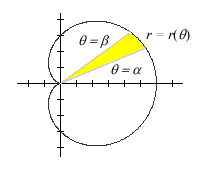
A = Area of the region enclosed by the curve and the two rays
r(θ) = The polar function giving the distance from the origin to the curve at angle θ
α = The starting angle (lower limit of integration)
β = The ending angle (upper limit of integration), with α < β
θ = The polar angle, measured from the positive x-axis
Worked Example
Problem: Find the area enclosed by one petal of the rose curve r = 4 sin(2θ).
Step 1: Identify the limits. One petal of r = 4 sin(2θ) is traced when sin(2θ) ≥ 0. The first petal runs from θ = 0 to θ = π/2, where sin(2θ) = 0 at both endpoints.
α=0,β=2π
Step 2: Set up the polar area formula with r² = 16 sin²(2θ).
A=21∫0π/2[4sin(2θ)]2dθ=21∫0π/216sin2(2θ)dθ
Step 3: Use the power-reduction identity sin²(u) = (1 − cos(2u))/2 with u = 2θ.
This example differs because r² is given directly by the equation, so you substitute it straight into the formula without squaring a separate r(θ). It also uses a lemniscate rather than a rose curve and has non-symmetric limits of integration.
Problem: Find the area of the region bounded by the lemniscate r² = 2 cos θ, the origin, and the rays θ = −π/6 and θ = π/4.
Step 1: Because the formula uses r², and the curve gives r² = 2 cos θ directly, substitute r² into the area formula.
A=21∫−π/6π/4r2dθ=21∫−π/6π/42cosθdθ
Step 2: Simplify the constant and integrate cos θ.
A=∫−π/6π/4cosθdθ=[sinθ]−π/6π/4
Step 3: Evaluate at the bounds.
A=sin(4π)−sin(−6π)=22−(−21)=22+21
Step 4: Write the answer in a combined form.
A=22+1
Answer: The area is (√2 + 1)/2 ≈ 1.207.
Frequently Asked Questions
Why is there a ½ in the polar area formula?
The formula works by summing infinitesimally thin circular sectors. Each sector with radius r and small angle dθ has area ½·r²·dθ, just as the area of a circular sector is ½r²θ. Integrating these tiny sectors from α to β produces the ½ factor in front of the integral.
How do you find the area between two polar curves?
If the outer curve is r₁(θ) and the inner curve is r₂(θ) between θ = α and θ = β, the enclosed area is A = ½∫[r₁(θ)]² − [r₂(θ)]² dθ. You must first determine which curve is farther from the origin over the interval and find the angles where the curves intersect to set correct limits.
How do you choose the correct limits of integration for a polar area problem?
Set r(θ) = 0 or find where two curves intersect to locate the boundary angles. For symmetric curves like roses or cardioids, you can often integrate over one symmetric piece and multiply. Always sketch the curve or check a table of values to make sure you are covering exactly the region you want.
Area Using Polar Coordinates vs. Area Under a Curve (Cartesian)
Area Using Polar Coordinates
Area Under a Curve (Cartesian)
Coordinate system
Polar: (r, θ)
Cartesian: (x, y)
Key formula
A = ½ ∫ [r(θ)]² dθ
A = ∫ f(x) dx (or ∫ |f(x)| dx)
Geometric building block
Thin circular sectors
Thin vertical or horizontal rectangles
When to use
Curves naturally expressed in r and θ (spirals, roses, cardioids, lemniscates)
Curves naturally expressed as y = f(x) or x = g(y)
Area between two curves
½ ∫ (r₁² − r₂²) dθ
∫ (f(x) − g(x)) dx
Why It Matters
You encounter this formula in AP Calculus BC, college Calculus II, and multivariable calculus courses. Many curves—spirals, cardioids, roses, lemniscates—have simple polar equations but extremely complicated Cartesian forms, making the polar area integral the most practical (and sometimes the only feasible) way to compute enclosed areas. Mastering it also prepares you for double integrals in polar coordinates, a technique used throughout physics and engineering.
Common Mistakes
Mistake: Forgetting the ½ factor and writing A = ∫ r² dθ.
Correction: The area of a circular sector is ½r²θ, so the correct formula is A = ½ ∫ r² dθ. Always include the ½.
Mistake: Using wrong limits by not sketching the curve, which leads to counting extra area or missing part of the region.
Correction: Before integrating, find where r(θ) = 0 or where curves intersect to determine the exact angles. Sketch the curve or plot key points to confirm you integrate over the intended region only.