
Power Series
Power Series
A series which represents a function as a polynomial that goes on forever and has no highest power of x.
See also
Factorial, Maclaurin series, Taylor series, convergence tests, derivative of a power series, integral of a power series, power series convergence, radius of convergence
Key Formula
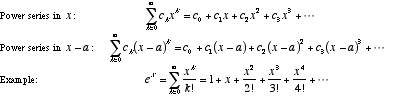
n=0∑∞an(x−c)n=a0+a1(x−c)+a2(x−c)2+a3(x−c)3+⋯
Where:
- an = The coefficient of the nth term, which may follow a pattern or formula
- x = The variable; the series defines a function of x
- c = The center of the power series (when c = 0, the series is centered at the origin)
- n = The index of summation, running from 0 to infinity
Worked Example
Problem: Write the power series representation of f(x)=1−x1 centered at c=0, and determine for which values of x it converges.
Step 1: Recognize the geometric series formula. A geometric series with first term 1 and common ratio x sums to 1−x1 when ∣x∣<1.
1−x1=n=0∑∞xn
Step 2: Expand the first several terms to see the pattern. Here every coefficient an=1 and the center c=0.
1−x1=1+x+x2+x3+x4+⋯
Step 3: Apply the ratio test to find the radius of convergence. Compute the limit of the ratio of consecutive terms.
n→∞limxnxn+1=∣x∣
Step 4: The series converges when the ratio is less than 1, so ∣x∣<1. The radius of convergence is R=1, and the interval of convergence is (−1,1).
∣x∣<1⟹R=1
Answer: The power series representation is 1−x1=∑n=0∞xn=1+x+x2+x3+⋯, valid for ∣x∣<1.
Another Example
This example uses factorial coefficients (unlike the constant coefficients in Example 1) and shows a power series with an infinite radius of convergence, meaning it converges everywhere.
Problem: Find the power series representation of ex centered at c=0 and verify the first four terms by evaluating at x=1.
Step 1: The Maclaurin series (power series centered at 0) for ex uses the fact that every derivative of ex evaluated at 0 equals 1. So an=n!1.
ex=n=0∑∞n!xn
Step 2: Write out the first four terms explicitly.
ex=1+x+2x2+6x3+⋯
Step 3: Substitute x=1 into the first four terms to approximate e1=e.
1+1+21+61=38≈2.6667
Step 4: Compare with the actual value e≈2.7183. The four-term approximation is already close. Adding more terms brings the sum closer to e.
Error≈2.7183−2.6667=0.0516
Step 5: Determine convergence. The ratio test gives limn→∞n+1∣x∣=0 for all x, so this power series converges for every real number. The radius of convergence is R=∞.
R=∞
Answer: The power series is ex=∑n=0∞n!xn, converging for all real x. At x=1, four terms give approximately 2.667, close to e≈2.718.
Frequently Asked Questions
What is the difference between a power series and a Taylor series?
A power series is any series of the form ∑an(x−c)n with arbitrary coefficients. A Taylor series is a specific power series where the coefficients are determined by the derivatives of a known function: an=n!f(n)(c). Every Taylor series is a power series, but not every power series arises as the Taylor series of a function.
How do you find the radius of convergence of a power series?
The most common method is the ratio test. Compute L=limn→∞anan+1. Then the radius of convergence is R=L1. If L=0, the series converges for all x (R=∞). If L=∞, the series converges only at x=c (R=0). You must check the endpoints separately.
When do you use a power series?
Power series are used to approximate functions that are difficult to compute exactly, to solve differential equations, and to evaluate integrals that have no closed-form antiderivative. For instance, the series for ex, sinx, and ln(1+x) are standard tools in calculus, physics, and engineering.
Power Series vs. Taylor Series
| Power Series | Taylor Series | |
|---|---|---|
| Definition | Any infinite series ∑an(x−c)n with given coefficients | A power series whose coefficients come from derivatives of a specific function |
| Formula | ∑n=0∞an(x−c)n | ∑n=0∞n!f(n)(c)(x−c)n |
| Coefficients | Can be any sequence of numbers | Determined by an=f(n)(c)/n! |
| Center at 0 | Power series centered at 0 | Called a Maclaurin series |
| When to use | General framework for representing functions as infinite polynomials | When you know a function and want to expand it around a specific point |
Why It Matters
Power series appear throughout calculus, physics, and engineering whenever you need to express a complicated function as an infinite polynomial. In AP Calculus BC and university courses, you will use them to approximate functions like sinx and ex, solve differential equations that resist other methods, and compute definite integrals that have no elementary antiderivative. Understanding power series also lays the foundation for Fourier series and other advanced representations of functions.
Common Mistakes
Mistake: Forgetting to check convergence at the endpoints of the interval.
Correction: The ratio test determines the open interval ∣x−c∣<R, but the series may or may not converge at x=c−R and x=c+R. You must test each endpoint individually using another convergence test (e.g., alternating series test, p-series test).
Mistake: Assuming a power series converges everywhere just because it represents a well-known function.
Correction: Many functions have power series that converge only within a finite radius. For example, 1−x1=∑xn diverges for ∣x∣≥1 even though 1−x1 is defined for all x=1. Always compute the radius of convergence.
Related Terms
- Taylor Series — Power series with coefficients from derivatives of a function
- Maclaurin Series — Taylor series centered at zero
- Radius of Convergence — Determines where a power series converges
- Power Series Convergence — Tests and criteria for when the series sums to a finite value
- Convergence Tests — Methods like ratio test used to find convergence
- Derivative of a Power Series — Differentiate term by term within the radius
- Integral of a Power Series — Integrate term by term within the radius
- Series — General concept of summing infinite sequences