
Point of Symmetry
Point of Symmetry
A special center point for certain kinds of symmetric figures or graphs. If a figure or graph can be rotated 180° about a point P and end up looking identical to the original, then P is a point of symmetry.
| Example: |
This is a graph of the curve |
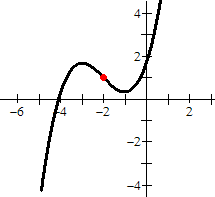
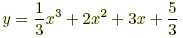 together with its point of symmetry (–2, 1).
See also
Key Formula
If (a,b) is on the graph, then (2h−a,2k−b) is also on the graph.
Where:
- (h,k) = The candidate point of symmetry
- (a,b) = Any point on the figure or graph
- (2h−a,2k−b) = The point that must also lie on the figure for symmetry to hold
Worked Example
Problem: Show that the function f(x) = x³ has a point of symmetry at the origin (0, 0).
Step 1: Identify the candidate point of symmetry. Here (h, k) = (0, 0).
P=(0,0)
Step 2: Pick any point on the graph. Choose x = 2, so f(2) = 8. The point (2, 8) is on the curve.
f(2)=23=8
Step 3: Apply the symmetry formula to find the reflected point: (2h − a, 2k − b) = (0 − 2, 0 − 8) = (−2, −8).
(2(0)−2,2(0)−8)=(−2,−8)
Step 4: Check whether (−2, −8) is on the graph. Compute f(−2).
f(−2)=(−2)3=−8✓
Step 5: This works for every point because f(−x) = −f(x), meaning the function is odd. The origin is the point of symmetry.
Answer: The origin (0, 0) is the point of symmetry of f(x) = x³.
Another Example
This example involves a translated cubic, showing how shifts in the parent function move the point of symmetry away from the origin.
Problem: Find the point of symmetry of the cubic function f(x) = (x + 2)³ + 1.
Step 1: Recognize the structure. This is a shifted cubic: the parent function x³ has been translated 2 units left and 1 unit up.
f(x)=(x+2)3+1
Step 2: The parent function x³ has its point of symmetry at (0, 0). A horizontal shift of −2 and a vertical shift of +1 moves the center to (−2, 1).
(h,k)=(−2,1)
Step 3: Verify with a specific point. At x = 0: f(0) = (0 + 2)³ + 1 = 9. The reflected point should be (2(−2) − 0, 2(1) − 9) = (−4, −7).
f(0)=8+1=9⇒(2(−2)−0,2(1)−9)=(−4,−7)
Step 4: Check: f(−4) = (−4 + 2)³ + 1 = (−2)³ + 1 = −8 + 1 = −7. The reflected point lies on the graph.
f(−4)=(−2)3+1=−7✓
Answer: The point of symmetry is (−2, 1).
Frequently Asked Questions
What is the difference between a point of symmetry and an axis of symmetry?
An axis of symmetry is a line (such as the vertical line through a parabola's vertex) across which a figure reflects onto itself. A point of symmetry is a single point about which a figure can be rotated 180° and map onto itself. An axis involves reflection; a point of symmetry involves half-turn rotation.
How do you find the point of symmetry of a cubic function?
For a general cubic f(x) = a(x − h)³ + k, the point of symmetry (also called the inflection point) is (h, k). You can find it by computing the second derivative and setting it equal to zero to locate the x-coordinate, then substituting back into f(x) for the y-coordinate.
Does every function have a point of symmetry?
No. Only functions (or figures) with 180° rotational symmetry have a point of symmetry. For example, parabolas like y = x² have an axis of symmetry but no point of symmetry. Odd functions such as y = x³ and y = sin(x) do have points of symmetry.
Point of Symmetry vs. Axis of Symmetry
| Point of Symmetry | Axis of Symmetry | |
|---|---|---|
| Definition | A single point about which a figure maps onto itself after a 180° rotation | A line across which a figure reflects onto itself |
| Type of transformation | Rotation (half-turn, 180°) | Reflection (mirror image) |
| Common examples | Cubic functions, odd functions, the center of a regular hexagon | Parabolas, isosceles triangles, regular polygons |
| How to find it | Set the second derivative to zero (for cubics), or test f(2h − x) = 2k − f(x) | Use x = −b/(2a) for a quadratic, or find the perpendicular bisector |
Why It Matters
You encounter points of symmetry when graphing cubic functions, rational functions, and other odd-type curves in algebra and precalculus. Knowing the point of symmetry immediately gives you the inflection point of a cubic and helps you sketch the graph quickly by plotting points on one side and reflecting them through the center. It also appears in geometry when classifying figures by their rotational symmetry, such as parallelograms and regular polygons with an even number of sides.
Common Mistakes
Mistake: Confusing point symmetry with line symmetry. Students often assume that because a parabola is symmetric, it must have a point of symmetry.
Correction: A parabola has an axis of symmetry (a line), not a point of symmetry. A figure needs 180° rotational symmetry — not just mirror symmetry — to have a point of symmetry.
Mistake: Testing only one pair of points and concluding symmetry holds for the whole graph.
Correction: One verified pair is not sufficient proof. You must show the relationship holds for all points, typically by proving algebraically that f(2h − x) = 2k − f(x) for every x in the domain.
Related Terms
- Symmetric — General property that includes point symmetry
- Symmetric with Respect to the Origin — Special case where the point of symmetry is (0,0)
- Axis of Symmetry — Line symmetry, often compared to point symmetry
- Point — The geometric object that serves as the center
- Graph of an Equation or Inequality — Visual representation where point symmetry is observed
- Curve — Curves such as cubics often have a point of symmetry
- Geometric Figure — Shapes that may possess rotational symmetry
- Vertical Line Equation — Used in vertical line tests and axis of symmetry formulas