
p-series
p-series
A series of the form 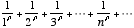 or
or  ,
where p > 0. Often employed when using the comparison
test and the limit
comparison test.
,
where p > 0. Often employed when using the comparison
test and the limit
comparison test.
Note: The harmonic series is a p-series with p =1.

See also
Key Formula
n=1∑∞np1=1p1+2p1+3p1+⋯
Where:
- n = The index of summation, starting at 1 and increasing through all positive integers
- p = A positive constant that determines convergence: the series converges if p > 1 and diverges if 0 < p ≤ 1
Worked Example
Problem: Determine whether the p-series ∑n=1∞n31 converges or diverges.
Step 1: Identify the series as a p-series and find the value of p.
n=1∑∞n31⟹p=3
Step 2: Apply the p-series convergence rule: a p-series converges if and only if p > 1.
p=3>1
Step 3: Since p = 3 is greater than 1, the condition for convergence is satisfied.
n=1∑∞n31 converges
Answer: The series ∑n=1∞n31 converges because p=3>1.
Another Example
This example shows how a p-series is commonly used as a benchmark in the comparison test rather than being tested directly.
Problem: Use the p-series test and the comparison test to determine whether ∑n=1∞n2+51 converges or diverges.
Step 1: Notice that this is NOT itself a p-series because the denominator is n2+5, not np. However, for large n it behaves like n21, which is a p-series with p=2.
n2+51vs.n21
Step 2: Since n2+5>n2 for all n≥1, the given terms are smaller than the corresponding p-series terms.
0<n2+51<n21for all n≥1
Step 3: Confirm that the comparison series ∑n21 converges by the p-series test (p=2>1).
n=1∑∞n21 converges (p=2>1)
Step 4: By the direct comparison test, since each term of our series is positive and less than the corresponding term of a convergent series, our series also converges.
n=1∑∞n2+51 converges by comparison
Answer: The series ∑n=1∞n2+51 converges by the comparison test with the convergent p-series ∑n21.
Frequently Asked Questions
What is the difference between a p-series and a geometric series?
A p-series has the form np1 where the variable n is in the base of the denominator. A geometric series has the form arn where the variable n is in the exponent. A geometric series converges when ∣r∣<1, while a p-series converges when p>1. They are tested with entirely different convergence criteria.
Why does the p-series diverge when p = 1?
When p=1, the p-series becomes the harmonic series ∑n1=1+21+31+⋯, which diverges. Even though the individual terms approach zero, they decrease too slowly for the partial sums to remain bounded. This can be proven using the integral test: ∫1∞x1dx=lnx1∞=∞.
How do you prove the p-series convergence rule?
The standard proof uses the integral test. You compare ∑np1 with the improper integral ∫1∞xp1dx. When p>1, this integral equals p−11, which is finite, so the series converges. When p≤1, the integral diverges, so the series diverges.
p-Series vs. Geometric Series
| p-Series | Geometric Series | |
|---|---|---|
| General form | ∑n=1∞np1 | ∑n=0∞arn |
| Variable position | n is in the base of the denominator | n is in the exponent |
| Convergence condition | Converges when p>1 | Converges when ∣r∣<1 |
| Exact sum known? | Only for specific values of p (e.g., p=2 gives π2/6) | Yes: sum =1−ra |
| Common use | Benchmark for comparison and limit comparison tests | Direct evaluation of sums; ratio test benchmark |
Why It Matters
The p-series is one of the most important benchmark series in calculus. When you need to determine whether an unfamiliar series converges, you will frequently compare it to a p-series using the comparison test or the limit comparison test. Mastering the simple rule — converges if p>1, diverges if p≤1 — gives you a powerful tool for quickly resolving many series convergence problems on AP Calculus and college calculus exams.
Common Mistakes
Mistake: Thinking the p-series converges when p = 1 because the terms n1 approach zero.
Correction: Terms approaching zero is necessary but not sufficient for convergence. The harmonic series (p=1) is the classic example of a divergent series whose terms tend to zero. You must have p>1 strictly.
Mistake: Confusing a p-series with a geometric series by misidentifying where the variable n appears.
Correction: In a p-series, n is the base raised to a constant power: np1. In a geometric series, a constant base is raised to the variable power: rn. Check whether the variable is in the base or the exponent before choosing your test.
Related Terms
- Series — General concept that p-series is a special case of
- Comparison Test — Often uses p-series as the benchmark series
- Limit Comparison Test — Frequently pairs unknown series with a p-series
- Harmonic Series — The divergent p-series where p = 1
- Convergent Series — A p-series is convergent when p > 1
- Divergent Series — A p-series is divergent when p ≤ 1
- Sigma Notation — Notation used to write p-series compactly