c = A critical point — a candidate location for an extremum
f′(c) = The first derivative of f evaluated at c
Worked Example
Problem: Find all extrema of the function f(x) = x³ − 12x + 5 on the entire real line.
Step 1: Find the first derivative of f(x).
f′(x)=3x2−12
Step 2: Set the derivative equal to zero and solve for x to find critical points.
3x2−12=0⟹x2=4⟹x=−2 or x=2
Step 3: Use the second derivative test. Compute f''(x) and evaluate it at each critical point.
f′′(x)=6x⟹f′′(−2)=−12<0,f′′(2)=12>0
Step 4: Since f''(−2) < 0, x = −2 is a local maximum. Since f''(2) > 0, x = 2 is a local minimum. Compute the function values.
f(−2)=(−2)3−12(−2)+5=21f(2)=(2)3−12(2)+5=−11
Answer: The function has a local maximum (extremum) of 21 at x = −2 and a local minimum (extremum) of −11 at x = 2. Because f(x) → ∞ as x → ∞ and f(x) → −∞ as x → −∞, there are no absolute extrema.
Another Example
This example shows how to find absolute (global) extrema on a closed interval using the Closed Interval Method (evaluate at critical points and endpoints), unlike the first example which found only local extrema on the entire real line.
Problem: Find the absolute extrema of f(x) = x³ − 3x on the closed interval [−2, 3].
Step 1: Find the derivative and set it equal to zero.
f′(x)=3x2−3=0⟹x2=1⟹x=−1 or x=1
Step 2: Both critical points lie inside the interval [−2, 3], so both are candidates. Also include the endpoints x = −2 and x = 3.
Step 4: Compare all values. The largest is the absolute maximum and the smallest is the absolute minimum.
Answer: The absolute maximum extremum is 18 at x = 3, and the absolute minimum extremum is −2, which occurs at both x = −2 and x = 1.
Frequently Asked Questions
What is the difference between a local extremum and an absolute extremum?
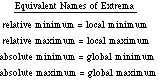
A local (relative) extremum is a point where the function value is larger or smaller than at all nearby points. An absolute (global) extremum is the single largest or smallest value the function attains over its entire domain (or a specified interval). Every absolute extremum is also a local extremum, but not every local extremum is an absolute one.
What is the plural of extremum?
The plural of extremum is extrema. So you would say 'the function has two extrema' when referring to multiple extreme values.
Can an extremum occur where the derivative is undefined?
Yes. An extremum can occur at a point where the derivative does not exist, such as a cusp or a corner. For example, f(x) = |x| has an absolute minimum at x = 0, where f'(0) is undefined. This is why both f'(c) = 0 and points where f'(c) does not exist must be checked.
Local (Relative) Extremum vs. Absolute (Global) Extremum
Local (Relative) Extremum
Absolute (Global) Extremum
Definition
f(c) is greater than or less than all nearby values
f(c) is the greatest or least value on the entire domain or interval
How many can exist
A function can have many local extrema
At most one absolute max value and one absolute min value (though each may occur at multiple points)
How to find
First or second derivative test at critical points
Compare all critical point values and endpoint values (on closed intervals), or analyze end behavior
Guaranteed to exist?
Not guaranteed — some functions have none
Guaranteed on a closed interval for continuous functions (Extreme Value Theorem)
Why It Matters
Finding extrema is one of the central tasks in calculus and appears throughout optimization problems — from maximizing profit or minimizing cost in applied math to finding the lowest point on a curve in physics. Many exam questions in AP Calculus, SAT Subject Tests, and university courses ask you to locate and classify extrema. Understanding extrema also builds toward deeper topics like curve sketching, Lagrange multipliers, and real analysis.
Common Mistakes
Mistake: Assuming every critical point is an extremum.
Correction: A critical point where f'(c) = 0 could be an inflection point instead of an extremum. For example, f(x) = x³ has f'(0) = 0 but no extremum at x = 0. Always verify with the first or second derivative test.
Mistake: Forgetting to check endpoints when finding absolute extrema on a closed interval.
Correction: The Extreme Value Theorem guarantees that a continuous function on [a, b] attains its absolute max and min, but these can occur at the endpoints, not just at interior critical points. Always evaluate f at a and b as well.
Related Terms
Function — The object whose extreme values are studied