Arc of a Circle
A connected section
of the circumference of a circle.
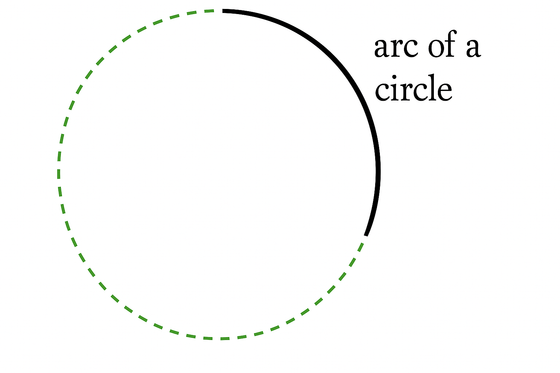
Arcs
are measured in two ways: as the measure of the central
angle,
or as the length of the arc itself.
Measurement by central angle
(degrees)
|
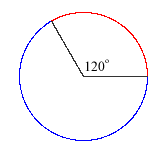 |
The red arc (minor arc) measures
120°.
The blue arc (major arc) measures 240°.
|
Measurement by arc length
(radians) |
 |
Formula: s = rθ
s = arc length
r = radius of the circle
θ = measure of the central angle in radians
Red arc: r = 2 and θ = 2π/3,
so s = 4π/3
Blue arc: r = 2 and θ = 4π/3,
so s = 8π/3
|
See
also
Arc
length of a curve
Worked Example
Problem: A circle has a radius of 10 cm. Find the length of an arc that subtends a central angle of 90°.
Step 1: Convert the central angle from degrees to radians. Multiply by π/180.
θ=90°×180°π=2π radians Step 2: Write down the arc length formula.
Step 3: Substitute the known values: r = 10 cm and θ = π/2.
s=10×2π=5π Step 4: Compute the decimal approximation if needed.
s=5π≈15.71 cm Answer: The arc length is 5π cm, or approximately 15.71 cm.
Another Example
This example works in reverse — given the arc length, you solve for the central angle instead of computing the arc length from a given angle.
Problem: An arc on a circle of radius 6 m has a length of 9 m. Find the central angle in both radians and degrees.
Step 1: Start with the arc length formula and solve for θ.
s=rθ⟹θ=rs Step 2: Substitute s = 9 and r = 6.
θ=69=1.5 radians Step 3: Convert to degrees by multiplying by 180°/π.
θ=1.5×π180°≈85.94° Answer: The central angle is 1.5 radians, or approximately 85.94°.
Frequently Asked Questions
What is the difference between arc measure and arc length?
Arc measure is the size of the central angle that the arc subtends, expressed in degrees or radians. Arc length is the actual distance along the curved path of the arc, measured in linear units like centimeters or meters. Two arcs can have the same arc measure but different arc lengths if they belong to circles of different radii.
What is the difference between a minor arc and a major arc?
A minor arc is the shorter arc connecting two points on a circle, with a central angle less than 180°. A major arc is the longer arc connecting those same two points, with a central angle greater than 180°. Together, a minor arc and its corresponding major arc make up the full circumference. A semicircle, with a central angle of exactly 180°, is neither minor nor major.
How do you find arc length using degrees instead of radians?
If the central angle is given in degrees, use the formula s = (θ/360) × 2πr, which represents the fraction of the full circumference. This is equivalent to converting to radians first and then applying s = rθ.
Arc Measure (central angle) vs. Arc Length
| Arc Measure (central angle) | Arc Length |
|---|
| What it describes | The angle at the center of the circle | The distance along the curve of the circle |
| Units | Degrees or radians (no linear unit) | Linear units (cm, m, in, etc.) |
| Formula | θ = s / r (in radians) | s = rθ |
| Depends on radius? | No — same angle regardless of circle size | Yes — larger radius means longer arc for the same angle |
| Full circle value | 360° or 2π radians | 2πr (the full circumference) |
Why It Matters
Arcs appear throughout geometry — you need them to find sector areas, segment areas, and lengths of curved paths. In trigonometry, the concept of arc length on a unit circle is the foundation for radian measure and the definitions of sine and cosine. Real-world applications include calculating distances along curved roads, determining how far a wheel rolls in a partial rotation, and designing circular structures in engineering.
Common Mistakes
Mistake: Using degrees directly in the formula s = rθ without converting to radians.
Correction: The formula s = rθ requires θ in radians. If you have degrees, either convert first (multiply by π/180) or use the equivalent formula s = (θ/360) × 2πr.
Mistake: Confusing the arc measure (angle) with the arc length (distance).
Correction: Arc measure is an angle (e.g., 60° or π/3 radians) and has no linear units. Arc length is a distance along the circle measured in units like cm or m. Always check what the problem is asking for.
