
Angle of Depression
Angle of Depression
The angle below horizontal that an observer must look to see an object that is lower than the observer. Note: The angle of depression is congruent to the angle of elevation (this assumes the object is close enough to the observer so that the horizontals for the observer and the object are effectively parallel; this would not be the case for an astronaut in orbit around the earth observing an object on the ground).
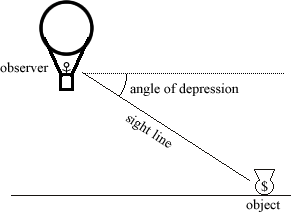
Key Formula
tan(θ)=horizontal distancevertical distance
Where:
- θ = The angle of depression, measured from the horizontal down to the line of sight
- vertical distance = The height difference between the observer and the object below
- horizontal distance = The horizontal distance from the observer to the point directly below or above the object
Worked Example
Problem: A lifeguard sits in a tower 12 meters above the beach. She spots a swimmer in the water at an angle of depression of 30°. How far is the swimmer from the base of the tower?
Step 1: Draw a right triangle. The vertical leg is the tower height (12 m). The horizontal leg is the unknown distance from the base of the tower to the swimmer. The angle of depression is 30°, measured from the horizontal at the top of the tower down to the line of sight.
Step 2: Because the angle of depression from the lifeguard equals the angle of elevation from the swimmer (alternate interior angles with parallel horizontals), the angle inside the triangle at the swimmer's position is also 30°. However, it is often easier to work directly with the angle at the top. The angle between the vertical tower and the line of sight is 90° − 30° = 60°.
Step 3: Using the angle of depression directly with tangent: tan(30°) equals the opposite side (height) over the adjacent side (horizontal distance).
tan(30°)=d12
Step 4: Solve for d by rearranging the equation.
d=tan(30°)12=3112=123≈20.8 m
Answer: The swimmer is approximately 20.8 meters from the base of the lifeguard tower.
Another Example
Problem: From the top of a 50-meter cliff, a hiker observes a boat on the lake at an angle of depression of 45°. How far is the boat from the base of the cliff?
Step 1: Identify the known values: the cliff height is 50 m, and the angle of depression is 45°.
Step 2: Set up the tangent ratio using the angle of depression.
tan(45°)=d50
Step 3: Since tan(45°) = 1, solve for d.
d=150=50 m
Answer: The boat is 50 meters from the base of the cliff.
Frequently Asked Questions
What is the difference between angle of depression and angle of elevation?
The angle of depression is measured downward from the horizontal when you look at something below you. The angle of elevation is measured upward from the horizontal when you look at something above you. When one person looks down at another, the angle of depression from the first person equals the angle of elevation from the second person, because the two horizontal lines are parallel and the line of sight acts as a transversal creating alternate interior angles.
Is the angle of depression always equal to the angle of elevation?
Yes, for practical purposes on Earth's surface. The two angles are equal because the horizontal lines at the observer and the object are parallel, making them alternate interior angles. This equality breaks down only over extremely large distances (such as from orbit) where Earth's curvature means the two horizontal lines are no longer parallel.
Angle of Depression vs. Angle of Elevation
Both angles are measured between a horizontal line and a line of sight. The angle of depression is measured downward from the horizontal (observer is higher), while the angle of elevation is measured upward from the horizontal (observer is lower). In any given scenario, the two angles are congruent because they form alternate interior angles between parallel horizontal lines cut by the line of sight.
Why It Matters
The angle of depression is essential in real-world applications like surveying, navigation, and architecture. Pilots use it to calculate descent paths, and engineers use it to design ramps and drainage slopes. Any time you need to find a distance or height when you can measure the angle you look downward, trigonometry with the angle of depression gives you the answer.
Common Mistakes
Mistake: Placing the angle of depression inside the triangle at the observer, between the vertical side and the hypotenuse.
Correction: The angle of depression is measured from the horizontal line downward to the line of sight, not from the vertical. It sits outside the right triangle. The angle inside the triangle at the observer's vertex is the complement: 90° minus the angle of depression.
Mistake: Confusing which sides are opposite and adjacent when setting up the trigonometric ratio.
Correction: Relative to the angle of depression at the top of the triangle, the opposite side is the vertical height and the adjacent side is the horizontal distance. Always sketch the triangle and label the horizontal line, the angle, and the sides before writing any trig ratio.
Related Terms
- Angle of Elevation — The upward counterpart of angle of depression
- Angle — General concept that angle of depression builds on
- Horizontal — Reference line from which the angle is measured
- Congruent — Describes the equal relationship between both angles
- Parallel Lines — Explains why the two angles are equal
- Trigonometry — Branch of math used to solve depression angle problems
- Alternate Interior Angles — Theorem proving depression equals elevation angle