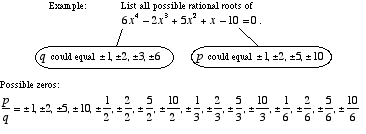
This list consists of all
possible numbers of the form c/d,
where c and d are integers. c must divide
evenly into the constant terma0. d must
divide evenly into the leading coefficientan.
Possible rational roots=±qp,where p∣a0 and q∣an
Where:
p = A factor (divisor) of the constant term a₀
q = A factor (divisor) of the leading coefficient aₙ
a0 = The constant term of the polynomial (the term with no variable)
an = The leading coefficient (the coefficient of the highest-degree term)
p∣a0 = p divides evenly into a₀
q∣an = q divides evenly into aₙ
Worked Example
Problem: Find all rational roots of the polynomial equation 2x³ + 3x² − 8x + 3 = 0.
Step 1: Identify the constant term a₀ and leading coefficient aₙ.
a0=3,an=2
Step 2: List all factors of a₀ = 3 (these are the possible values of p) and all factors of aₙ = 2 (these are the possible values of q).
p:±1,±3q:±1,±2
Step 3: Form all possible fractions ±p/q and simplify to remove duplicates.
Possible roots: ±1,±3,±21,±23
Step 4: Test each candidate by substituting into the polynomial. Start with x = 1.
2(1)3+3(1)2−8(1)+3=2+3−8+3=0✓
Step 5: Since x = 1 is a root, divide the polynomial by (x − 1) to get a quadratic, then solve.
2x3+3x2−8x+3=(x−1)(2x2+5x−3)=(x−1)(2x−1)(x+3)
Answer: The rational roots are x = 1, x = 1/2, and x = −3.
Another Example
This example shows two important variations: (1) when the constant term is 0, factor out x first before applying the theorem; (2) when the leading coefficient is 1, all rational roots must be integers.
Problem: Find all rational roots of x⁴ − 6x³ + 11x² − 6x = 0.
Step 1: Factor out the common factor x first, since the constant term is 0. A zero constant term means x = 0 is always a root.
x(x3−6x2+11x−6)=0
Step 2: Apply the Rational Root Theorem to the cubic factor. The constant term is −6 and the leading coefficient is 1.
a0=−6,an=1⇒Possible roots: ±1,±2,±3,±6
Step 3: When the leading coefficient is 1, the only possible rational roots are integer factors of the constant term. Test x = 1.
(1)3−6(1)2+11(1)−6=1−6+11−6=0✓
Step 4: Divide by (x − 1) and factor the resulting quadratic.
x3−6x2+11x−6=(x−1)(x2−5x+6)=(x−1)(x−2)(x−3)
Answer: The rational roots are x = 0, x = 1, x = 2, and x = 3.
Frequently Asked Questions
What is the difference between the Rational Root Theorem and the Factor Theorem?
The Rational Root Theorem generates a list of candidates that might be roots, based on the constant term and leading coefficient. The Factor Theorem says that if r is a root of a polynomial, then (x − r) is a factor. You typically use the Rational Root Theorem to find candidates, then the Factor Theorem to confirm them and factor the polynomial.
Does the Rational Root Theorem find all roots of a polynomial?
No. It only identifies possible rational roots — fractions and integers. A polynomial can also have irrational roots (like √2) or complex roots (like 3 + 2i), and the theorem will not find those. For example, x² − 2 = 0 has no rational roots at all, even though the theorem suggests ±1 and ±2 as candidates.
Can you use the Rational Root Theorem if the coefficients are not integers?
The theorem requires all coefficients to be integers. However, if your polynomial has fractional coefficients, you can multiply the entire equation by the least common denominator to clear the fractions. This produces an equivalent equation with integer coefficients, and then you can apply the theorem.
Rational Root Theorem vs. Descartes' Rule of Signs
Rational Root Theorem
Descartes' Rule of Signs
Purpose
Lists all possible rational roots of a polynomial
Counts the possible number of positive and negative real roots
What it tells you
Which specific values to test as potential roots
How many positive or negative roots exist (not which ones)
Limitations
Only finds rational roots; misses irrational and complex roots
Gives an upper bound on real roots but not their exact values
When to use
When you need to find exact rational solutions to a polynomial equation
When you want to narrow down the sign of potential roots before testing
Why It Matters
The Rational Root Theorem appears throughout Algebra 2 and Precalculus courses, especially when solving higher-degree polynomial equations by hand. It gives you a systematic starting point instead of random guessing, which is essential when factoring cubics or quartics. On standardized tests like the SAT and ACT, knowing this theorem lets you quickly identify which values to test when a problem asks for the zeros of a polynomial.
Common Mistakes
Mistake: Forgetting to include both positive and negative versions of each candidate.
Correction: Every fraction p/q on your list must appear as both +p/q and −p/q. A negative root is just as valid as a positive one.
Mistake: Assuming every candidate on the list is actually a root.
Correction: The theorem only provides possible roots. You must test each candidate by substituting it into the polynomial (or using synthetic division) to confirm whether it is an actual root. Most candidates on the list will not work.
Related Terms
Polynomial — The type of expression this theorem applies to