Mathwords logoMathwords

Interval Notation

Interval Notation

A notation for representing an interval as a pair of numbers. The numbers are the endpoints of the interval. Parentheses and/or brackets are used to show whether the endpoints are excluded or included. For example, [3, 8) is the interval of real numbers between 3 and 8, including 3 and excluding 8.
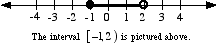
Number line from -4 to 4 showing interval [-1,2) with a closed dot at -1 and open dot at 2, shaded between them.

Note: Many authors use reversed brackets instead of parentheses. For example, ]5,7[ refers to the interval from 5 to 7, exclusive. The interval in the example below would be written [–1, 2[.

See also

Open interval, closed interval, half-open interval, half-closed interval, inclusive, exclusive

Key Formula

[a,b](a,b)[a,b)(a,b][a,\, b] \quad (a,\, b) \quad [a,\, b) \quad (a,\, b]
Where:
  • aa = The left (lower) endpoint of the interval
  • bb = The right (upper) endpoint of the interval
  • [  ][\;] = Square brackets mean the endpoint is included (≤ or ≥)
  • (  )(\;) = Parentheses mean the endpoint is excluded (< or >)

Worked Example

Problem: Write the solution set of the inequality 2<x5-2 < x \le 5 in interval notation.
Step 1: Identify the two endpoints. The left endpoint is 2-2 and the right endpoint is 55.
a=2,b=5a = -2, \quad b = 5
Step 2: Determine whether each endpoint is included or excluded. The symbol << (strict inequality) at 2-2 means 2-2 is excluded. The symbol \le at 55 means 55 is included.
Step 3: Choose the correct bracket or parenthesis for each side. Use a parenthesis at 2-2 (excluded) and a bracket at 55 (included).
Step 4: Write the interval with the left endpoint first, a comma, then the right endpoint.
(2,5](-2,\, 5]
Answer: The solution set in interval notation is (2,5](-2,\, 5].

Another Example

This example shows how to handle an unbounded interval that extends to infinity, which requires using the infinity symbol and always pairing it with a parenthesis.

Problem: Express the set of all real numbers greater than or equal to 4 in interval notation.
Step 1: Translate the phrase into an inequality. "Greater than or equal to 4" means x4x \ge 4.
x4x \ge 4
Step 2: Identify the endpoints. The left endpoint is 44 (included, because of \ge). There is no upper bound — the set extends to positive infinity.
Step 3: Use a bracket at 44 and a parenthesis at \infty. Infinity is never included because it is not a real number, so you always pair it with a parenthesis.
[4,)[4,\, \infty)
Answer: The set is [4,)[4,\, \infty).

Frequently Asked Questions

What is the difference between parentheses and brackets in interval notation?
Brackets [  ][\;] mean the endpoint is included in the set (the inequality uses \le or \ge). Parentheses (  )(\;) mean the endpoint is excluded (the inequality uses << or >>). For example, [2,7)[2, 7) includes 2 but does not include 7.
Do you use a bracket or parenthesis with infinity?
Always use a parenthesis with \infty or -\infty. Infinity is not a real number, so it can never be "reached" or included. Write (,5](-\infty, 5] or [3,)[3, \infty), never [,5][-\infty, 5].
How do you write a union of two intervals?
Use the union symbol \cup between the two intervals. For example, if x<1x < -1 or x3x \ge 3, you write (,1)[3,)(-\infty, -1) \cup [3, \infty). This means the set includes numbers from both intervals combined.

Interval Notation vs. Set-Builder Notation

Interval NotationSet-Builder Notation
FormatPair of endpoints with brackets/parentheses, e.g. [2,7)[2, 7)A rule describing elements, e.g. {x2x<7}\{x \mid 2 \le x < 7\}
ReadabilityVery compact; quick to read for simple intervalsMore flexible; can describe complex conditions
InfinityUses \infty or -\infty with parenthesesExpressed through the inequality, e.g. {xx>4}\{x \mid x > 4\}
When to useBest for continuous ranges of real numbersBest when the set has conditions beyond simple ranges

Why It Matters

Interval notation appears throughout algebra, precalculus, and calculus whenever you describe domains, ranges, or solution sets. When you study functions, you will state the domain as an interval — for instance, x\sqrt{x} has domain [0,)[0, \infty). Standardized tests and college-level courses expect you to read, write, and convert between interval notation and inequalities fluently.

Common Mistakes

Mistake: Using a bracket with infinity, such as writing [3,][3, \infty].
Correction: Infinity is not a real number and can never be included. Always use a parenthesis: [3,)[3, \infty).
Mistake: Reversing the endpoints, such as writing (5,2)(5, 2) instead of (2,5)(2, 5).
Correction: The smaller number must come first (on the left). An interval is always written with the lower endpoint before the upper endpoint.

Related Terms