Interest that
is, hypothetically, computed and added
to the balance of an account every instant.
This is not actually possible, but continuous compounding is well-defined
nevertheless as the upper bound of "regular" compound
interest. The formula, given below, is sometimes called the shampoo
formula (Pert®).
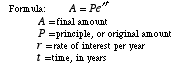
A = The final amount (principal plus interest) after time t
P = The principal — the initial amount of money invested or borrowed
e = Euler's number, approximately 2.71828
r = The annual interest rate expressed as a decimal (e.g., 5% = 0.05)
t = The time in years
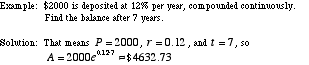
Worked Example
Problem: You invest $2,000 at an annual interest rate of 6%, compounded continuously. How much will you have after 5 years?
Step 1: Identify the known values: principal, rate, and time.
P=2000,r=0.06,t=5
Step 2: Write the continuously compounded interest formula.
A=Pert
Step 3: Substitute the values into the formula.
A=2000⋅e(0.06)(5)=2000⋅e0.3
Step 4:Evaluate e0.3 using a calculator.
e0.3≈1.34986
Step 5: Multiply to find the final amount.
A≈2000×1.34986=2699.72
Answer: After 5 years, the investment grows to approximately $2,699.72.
Another Example
This example works backward from a target amount, solving for the principal instead of the final balance. It shows how to rearrange the formula, which is a common variation on tests and in real financial planning.
Problem: You want to have $10,000 in an account that earns 4% interest compounded continuously. How much do you need to deposit now if you plan to wait 8 years?
Step 1:Identify the known values. Here the final amount A is known, and you need to find P.
A=10000,r=0.04,t=8
Step 2:Rearrange the formula to solve for the principal P.
P=ertA
Step 3: Compute the exponent.
rt=(0.04)(8)=0.32
Step 4:Evaluate e0.32 and divide.
e0.32≈1.37713⇒P≈1.3771310000≈7261.49
Answer: You need to deposit approximately $7,261.49 now to have $10,000 in 8 years.
Frequently Asked Questions
What is the difference between continuously compounded interest and compound interest?
Standard compound interest compounds at fixed intervals — monthly, quarterly, or annually — using the formula A=P(1+nr)nt. Continuously compounded interest is the theoretical limit of this formula as the number of compounding periods n approaches infinity, which simplifies to A=Pert. Continuous compounding always yields a slightly higher amount than any finite compounding frequency, but the difference is often small.
Why is it called the 'Pert' or 'shampoo' formula?
The formula A=Pert spells out 'P·e·r·t' when written in sequence, which matches the name of the shampoo brand Pert®. This mnemonic helps students remember the formula. Despite the playful name, the formula is used throughout mathematics, science, and finance.
When do you use the continuously compounded interest formula?
You use A=Pert whenever a problem states that interest is compounded "continuously." The same formula applies to any exponential growth or decay scenario — such as population growth, radioactive decay, or temperature change — where the rate of change is proportional to the current amount.
Continuously Compounded Interest vs. Compound Interest (n times per year)
Continuously Compounded Interest
Compound Interest (n times per year)
Formula
A=Pert
A=P(1+nr)nt
Compounding frequency
Infinite (every instant)
Finite: annually (n=1), monthly (n=12), daily (n=365), etc.
Result for same rate and time
Slightly higher — the theoretical maximum
Slightly lower — increases as n increases
Key constant
Uses e≈2.71828
No special constant needed
Typical use
Finance, calculus, natural growth/decay models
Banking, loans, most real-world savings accounts
Why It Matters
Continuously compounded interest appears in algebra, precalculus, and calculus courses as the primary example of exponential growth. Banks and financial institutions sometimes quote continuously compounded rates, so understanding the formula helps you compare investment options accurately. Beyond finance, the same A=Pert formula models radioactive decay (with a negative r), population growth, and Newton's law of cooling, making it one of the most widely applied formulas in mathematics and science.
Common Mistakes
Mistake:Using the percentage directly instead of converting to a decimal — for example, plugging in r=5 instead of r=0.05.
Correction:Always divide the percentage rate by 100 before substituting into the formula. An interest rate of 5% means r=0.05.
Mistake:Confusing the continuously compounded formula A=Pert with the standard compound interest formula A=P(1+r/n)nt and trying to include n in the continuous version.
Correction:The continuous formula has no n because compounding happens infinitely often — ert already accounts for that. If a problem says "compounded continuously," use A=Pert with no n variable.
Related Terms
Compound Interest — Finite-frequency version that continuous compounding generalizes
Interest — Broad concept covering simple and compound interest